


[71], and [72] discuss
a relation called sequence union to analyze discontinuous
constituents. The sequence union of the sequences s1, s2 and
s3 is true, iff each of the elements in s1 and s2 occur
in s3, and moreover, the original order of the elements in s1
and s2 is preserved in s3. For example, the sequence union of the
sequences
 a, b
a, b and
c, d
and s3 is
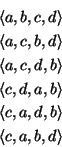
true, iff s3 is any of the
sequences:
and
c, d
and s3 is
true, iff s3 is any of the
sequences:
Reape presents an HPSG-style grammar [69] for German and Dutch
which uses the sequence union relation on word-order domains.
The grammar handles several word-order phenomena in German and Dutch.
Word-order domains are sequences of signs. The phonology of a
sign is the concatenation of the phonology of the elements of its
word-order domain. In `rules', the word-order domain of the mother
sign is defined in terms of the word-order domains of its daughter
signs. For example, in the ordinary case the word-order domain of the
mother simply consists of its daughter signs. Thus, for example, in
the rule
s  np vp the word-order domain associated with
s would consist of the sequence which consists of the signs
associated with np and vp.
However, in specific
cases it is also possible that the word-order domain of the mother consists
of the elements of the word-order domains of the daughters. Thus,
in case of a rule
x
yz in which the word-order domain
associated with y is the sequence
y1, y2, and the
word-order domain associated with z is
z1, then the
word-order domain associated with x is any of the sequences
y1, y2, z,
y1, z, y2,
z, y1, y2.
np vp the word-order domain associated with
s would consist of the sequence which consists of the signs
associated with np and vp.
However, in specific
cases it is also possible that the word-order domain of the mother consists
of the elements of the word-order domains of the daughters. Thus,
in case of a rule
x
yz in which the word-order domain
associated with y is the sequence
y1, y2, and the
word-order domain associated with z is
z1, then the
word-order domain associated with x is any of the sequences
y1, y2, z,
y1, z, y2,
z, y1, y2.
The following German example by Reape clarifies the approach, where I use indices to indicate to which verb an object belongs.
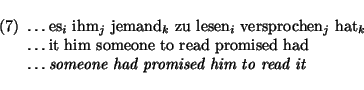
It is assumed that a `flat' verb phrase rule selects the arguments of
a verb (in one go), and that furthermore in case of a vp argument, the
word-order domain of this vp is sequence-unioned with the word-order
domain of the verb; the non-vp arguments of the verb become simply
members of the word-order domain of the mother of this verb-phrase
rule. Figure 4.4 shows a parse tree of this sentence, where
the nodes of the derivation tree are labelled by the string associated
with that node. The indices relate verbs with their arguments. This
tree can be read in a bottom-up fashion, as follows. Firstly, the verb
`zu lesen' selects an np, resulting in a verb-phrase with word-order
domain
npi, vi. This verb-phrase is one of the
arguments of the verb `versprochen'. As this argument is a verb-phrase
its word-order domain is sequence-unioned. A (possible) result is the
word-order domain
npi, npj, vi, vj. The verb
`hat' also selects an np and a vp. The elements of the vp are sequence
unioned, the np is simply added to the word-order domain, which
results in a possible word-order domain
npi, npj, npk, vi, vj, vk. Note that strings are defined with respect
to word-order domains. Sequence union is defined on such domains.
The strings of the derivation tree are thus only indirectly related
through the corresponding word-order domains.
![\begin{figure}
\begin{center}
\leavevmode
\unitlength1pt
\beginpicture
\setplot...
...on
\put{\hbox{$es_i$}} [Bl] at 283.77 18.00
\endpicture
\end{center}\end{figure}](img271.png) |