 Up to general Table of Contents
In this chapter, it will be considered what the implications of the acquisition data are for the issue raised in the beginning of this dissertation: how can children be expected to acquire the restricted distribution of NPIs in the absence of negative evidence? One possible route was mapped out in Chapter 1: if children employed a strategy of conservative widening, overgeneralization errors would not occur and there would be a steady expansion of licensers in the order from strong to weak. It turned out that the acquisition data indeed to a large extent are in accordance with these predictions. There is, however, one crucial refutation: the distribution of NPIs in the children's speech displays several non-adult-like patterns, which strictly speaking are errors.
As both the experimental study and a reanalysis of the spontaneous speech data have shown, these deviant patterns are not what they may look like at first sight. Rather than being violations of licensing, they are approximations of adult licensing rules, rooted in a restriction which in principle is correct: in the children's speech, NPIs only occur in environments which are linked to negative polarity.
This has important consequences for the issue of negative evidence in the acquisition of NPIs. The fact that children already from onset adhere to a licensing principle which is basically correct relieves the burden on negative evidence for acquiring the adult rules of licensing. The development towards completely adult-like usage does not depend on negative evidence to unlearn overgeneralizations, but rather involves adjusting the set of environments to which NPIs already are restricted, until these have all the features and qualities which make up correct licensers in adult speech.
This chapter provides a sketch of this process, in which pseudo-licensers have to withdraw in favor of a larger variety of correct licensers. First, the disappearance of early pseudo-licensers will be reviewed in the light of the general development of negation. After that, the focus will be on developments at a later age. This includes a grammaticality judgment test with 7- to 14-year-olds, to assess what these children and teenagers reject and accept as environments for hoeven.
Up to Chapter 5 Table of ContentsIn theory, there is a way in which children could bypass the `no negative evidence problem' and acquire the restricted distribution of NPIs entirely on the basis of positive evidence. This strategy was set out in the end of Chapter 1: if children started out with the narrowest possible generalization and only widened this rule when positive evidence had proven it to be too narrow, they would never overgeneralize NPIs to non-licensing environments and hence, they would not be dependent on negative evidence to unlearn such errors. In combination with Zwarts' formal semantic theory of licensing, this led to some predictions about how the acquisition of NPIs would proceed:
In the light of these data, what should be concluded about the possible role of conservative widening in NPI acquisition? Taken into account that the vast majority of children's utterances is in accordance with the predictions and points at a gradual widening of licensing rules, should the fact that NPIs sometimes are used in non-licensing environments be considered as enough counter evidence to abandon the whole idea of rule expansion in NPI acquisition?
As was pointed out in the preceding chapter, the deviant patterns in children's NPI use are no blatant violations of the principle of licensing. They should therefore not be regarded as real errors, but instead as representations of pseudo-licensing. In other words, the deviations do not represent the kind of errors that the strategy of conservative widening was meant to exclude: overgeneralizations. This reduces the power of the no-error prediction to falsify the basic idea behind this principle in the acquisition of NPI licensing. The fact that NPIs in the children's speech sometimes are pseudo-licensed does not really interfere with the idea of gradual expanding licensing rules, but could well be integrated in it.
The view that will be put forth here is that the acquisition of NPIs indeed involves a gradual expansion of licensing rules, only in a more indirect way than what is predicted by the strategy of conservative widening as set forth in section 1.7.4. It will be argued that this widening of rules is not exclusively concerned with NPI licensers, but rather is a reflection of an expansion taking place elsewhere, in a closely related area: the acquisition of negation. Nonetheless, as will be set out below, this indirect expansion of licensing rules must also be considered as an effective constraint to prevent children from overgeneralizing with NPIs.
Up to Chapter 5 Table of ContentsAs was shown in Chapter 4, the environments in which NPIs occur in early child speech reflect the contents of the child's negation `vocabulary'. At a young age, children dispose over just one correct negation marker, which is very frequently used: classical negation. Apart from classical negation, they use several non-adult-like means to express negative meanings: headshaking, sentence-external anaphoric negation, and atypical intonation contour. Sometimes, negation is not even pronounced, or is replaced by e or ne. As the early spontaneous speech data showed, hoeven and meer occur in all these environments. From the age of about 2;04, the negation vocabulary starts to expand and the dominance of classical negation slowly decreases in favor of other negative expressions. Table 4.1, displaying the average ages at which these expressions appear, makes it clear that the general order of appearance is from strong to weak. The first expressions to show up after classical negation are regular negations, while minimal negations have still hardly occurred at the end of the corpus, at the age of about four. This development is reflected again in the distribution of NPIs from that age: niet (not) as licenser slowly gives way to other correct licensing expressions; first to regular negations, later also - although extremely rarely - to minimal negation.
Negation and NPI licensing thus are closely linked up with each other in acquisition: the distribution of NPIs follows the way prepared by negation. In tandem with expansion of the negation vocabulary, there is an expansion of the environments in which NPIs occur. In view of this, the fact that the expansion of NPI environments follows predictions made by the principle of conservative widening must not be attributed to application of this principle in the acquisition of NPIs, but rather as the reflection of negation development, which generally proceeds in the order from strong to weaker negative expressions.
Be it not by application of the principle of conservative widening, the close relationship of NPIs with negation in the children's speech also guarantees a restricted distribution of NPIs and a gradual expansion of the environments in which these expressions can occur. If children apply the restriction that NPIs must occur in a negative environment, the small negation vocabulary at a young age will result in an accordingly narrowly restricted distribution of NPIs. At a later age, with extended knowledge of what constitutes a negative environment, the set of environments for NPIs will also enlarge.
Conclusive evidence that children's restricted NPI use is rooted in negation development rather than in application of the principle of conservative widening is constituted by the children's early use of pseudo-licensers. If the principle of conservative widening were applied, such errors could not be accounted for, since this principle excludes generalizations for which input speech provides no positive evidence. With the distribution of NPIs being dependent on negation development, however, pseudo-licensing appears to be only reasonable. If the restriction in young children's grammar is that NPIs can only occur in negative environments, then this restriction concerns the total inventory of negative markers at that age, including constructions that do not have the status of correct licensers in adult grammar.
The fact that NPIs are restricted to environments which, in the child's own terms, are negative implies that it is first of all the semantics and pragmatics of NPIs that matters in the acquisition of licensing. The restricted distribution of NPIs in child speech is not unmotivated, as a mere fact of grammar that has to be adhered to. Rather, it is a principled restricted distribution, rooted in knowledge of the essence in NPI licensing: sensitivity to negative polarity. Although such a semantic-pragmatic approach does not always immediately result in the faultlessly licensing of NPIs, it must be considered as the key to the disappearance of these early pseudo-licensers, and the drive behind acquisition of a larger variety of licensers at a later age.
Before moving on to these matters, I will consider some crosslinguistic evidence for a principled restricted distribution of NPIs in child speech. As was pointed out in Chapter 1 (cf. section 1.5.4), NPIs are crosslinguistic variations on a universal theme. Although languages may differ as to which expressions in their lexicon are polarity sensitive, NPIs across languages adhere to basically the same distributive rules. Interestingly, this universal pattern underlying the distribution of NPIs is reflected in child speech data from different languages: children use NPIs in a restricted way, in combination with early negation markers as licensers or pseudo-licensers. For instance, the first NPIs to appear in child English - any, either, and yet (Van der Wal 1996) - have an early distribution which is remarkably similar to that of Dutch hoeven and meer, although these are completely different expressions which have nothing else in common than just their polarity sensitivity. Thus, any, either, and yet from their onset in the children's speech occur in the company of classical negation: [1]
| (1) | this is not a good book # not any pictures in it. (2;06.14) |
| (2) | I don't know that song. either. (2;06.19) |
| (3) | it's not working yet. (2;04.14) |
in utterances with anaphoric no:
| (4) | adult: | nothing in there. we got them all out. |
| child: | yeah ## no # any more in here. (2;07.14) | |
| (5) | adult: | you don't want the lamb to have it either? |
| child: | no lamb have a chair either. (2;00.24) |
| (6) | no ready yet. (1;10.30) |
and in sentences without a negation marker, where the context makes it clear that the utterance is intended to have a negative meaning:
| (7) | child: | that got any film[!] in it. (2;07.14) |
| adult: | well # you know # it's really not a camera. | |
| (8) | child: | the eh T I need a T eiger (= either). (2;07.01) |
| adult: | don't need the T either, no. | |
| (9) | child: | bite me yet. he bite me yet. (2;08.25) |
| adult: | he didn't bite you yet # but he will bite you # honey. |
Likewise, there is some anecdotal evidence from German that children use the early-occurring NPI brauchen (have to/need) in pseudo-licensing environments.[2] Stern, in diary notes about his daughter Hilde (available in the CHILDES database, MacWhinney 1995), reports that at the age of two, brauchen occurs in utterances like the following:
| (10) |
b(r)aucht die Hilde? (2 years;
Stern and Stern 1907) needs Hilde? |
| (11) |
nein, b(r)aucht die Hilde? (2 years;
Stern and Stern 1907) no (non-quant.), needs Hilde? |
The first example, (10), is a structurally affirmative utterance which nevertheless - according to Stern - had an intended negative meaning: die Hilde braucht doch nicht? (Hilde doesn't need it, does she?). In the second example, (11), brauchen is accompanied by the anaphoric negation nein (no), which cannot function as a licenser in adult grammar.
Also, Kürschner (1983) noted that both his children, at the age of about four, sometimes used brauchen without a licenser in utterances conveying a negative meaning, like in the following example:
| (12) |
ich brauche heute das Kinderzimmer aufr„umen. (4 years; Kürschner 1983) I need today the nursery to-tidy-up. |
Up to Chapter 5 Table of
ContentsWith negation as the forerunner of environments in which NPIs can occur, children adhere to the basic restriction regarding NPI use, thus averting overgeneralization errors. In this respect, the course steered by negation development must be regarded as safe. On the other hand, it may take the child on a detour, as some early markers of negative meaning in child speech do not coincide with correct NPI licensers. Although NPIs in combination with these negative markers do not represent a blatant violation of the principle of licensing, they are strictly speaking errors. This means that these pseudo-licensers somehow in the course towards completely adult-like use have to be unlearned.
Importantly, knowing where the pseudo-licensing patterns come from also gives the key to how they subsequently must disappear. At an early age, children use headshaking, anaphoric negation, and intonation contour in a non-adult-like manner, as sentential negations. Also, negation may be left unpronounced or may be replaced by a dummy syllable. With NPI development following the course of negation development, incorrect use of negation results in incorrect licensing. By the same causal relationship, however, negation development must also be considered as the cure for these errors. When children's use of negation matures and early, primitive negation markers are replaced by correct negative expressions, the repercussions on NPI use will be that pseudo-licensing disappears. The question then is not so much how children unlearn that headshaking, negative intonation contour, and anaphoric negation cannot license NPIs, but rather how children learn that headshaking, negative intonation contour, and anaphoric negation are not correct as sentential negations.
Within the study of negation development, this question has not been directly addressed; the focus is either on the function of early sentence negation or its underlying syntax (cf. Appendix B for a review of the literature). The question of how children's early negative markers in time disappear in favor of more mature forms will not be dealt with here either, as it falls outside the scope of this dissertation. It should, however, be pointed out that it is an indisputable observation that headshaking, anaphoric negation, and intonation contour with the function of sentential negations occur during only a relatively short period. At the age of four, they have completely disappeared from child speech, and so have the pseudo-licensing patterns based on these negation markers.
Pea (1980a) reports that headshaking in combination with affirmative utterances is a development `of only brief use', without specifically mentioning at what age the last example occurred in his corpus. The last example of this phenomenon in Dutch data is reported by Kaper (1975), from a three year old child. With respect to intonational negatives, Lord (1974) notes that this phenomenon gradually disappears when the negative forms can't and don't start to occur, at the age of about 2;01. At first, these new forms are used simultaneously with elevated intonation, but after some time they occur in utterances with normal intonation. At the age of 2;04, intonation contour as a negation marker has completely disappeared. As regards anaphoric negation, Drozd (1995), based on an extensive corpus of English child speech, reports that the last occurrence of sentence-initial no was found at the age of 3;04. In the Dutch corpus, the last example of sentence-initial nee is attested at 3;07.
Up to Chapter 5 Table of
ContentsTaking up where section 5.4 started: as children's early pseudo-licensers are rooted in the acquisition of negation, it is in the course of this development that they must disappear. Once these early pseudo-licensers have stopped to occur, however, children's use of NPIs still must be considered as non-adult-like in several ways. On the one hand, NPIs are licensed in only a handful of different environments. At the age of four - the age at which the corpus of recorded speech ends - only the classical negation niet (not) and the regular negations geen (no, quant.), niks (nothing), niemand (no one), and nooit (never) have been attested as licensers, but none of the range of other possible environments. On the other hand, children still use NPIs in environments which do not completely conform to adult licensing rules, to wit non-echoic contrastive denials, neutral questions, and nog (still).
Considering that NPI's in the children's speech are subject to a basically correct, principled restriction (cf. section 5.3), straightening these non-adult-like patterns must be viewed as a process of expansion and adjustment. NPIs are not restricted to a random set of environments, but their licensers share semantic and pragmatic properties. As children from the onset base their use of NPIs on a semantic-pragmatic restriction, they appear to be in the most advantageous position for straightening the last pseudo-licensers and picking up the larger variety of correct licensing environments. The respective processes, adjustment and expansion, will be considered in the following subsections, 5.5.1 and 5.5.2.
Up to Chapter 5 Table of
ContentsWith respect to contrastive denial, questions, and nog (still) as pseudo-licensers, it must be noted that these represent a state of affairs which is quite different from that of the earlier pseudo-licensers headshaking, anaphoric negation, intonation contour, and underarticulation. Whereas the latter resulted from a primitive and incorrect use of negation and thus had to be unlearned, the children's use of contrastive denial, questions, and nog (still), as was argued in Chapter 4, are sophisticated means of communication and come very close to ways of licensing used in adult discourse. These later pseudo-licensers then, need not be unlearned (i.e. they do not have to disappear), but rather have to be adjusted until they are in complete accordance with the finesses that characterize the use of these constructions as licensers in adult discourse. Children's questions with hoeven, discussed in Chapter 4, showed such a progression: whereas the earliest questions appeared to be neutral requests for information, the later ones were more rhetorically charged. Likewise, in utterances with hoeven expressing contrastive denial, there appears to be a progression towards explicit marking of contrast. Whereas at an early age, an implicit negative assumption seems to be sufficient to license hoeven, at a later age, the contrast in such utterances is explicitly expressed by the affirmative marker wel (indeed).
How exactly such fine-tuning is accomplished remains unanswered. Spontaneous speech data may offer rare glimpses of this process, for instance by self-corrections (cf. (13)), or corrections induced by requests for clarification (i.e. indirect negative evidence; cf. Hirsh-Pasek et al. 1984; Demetras et al. 1986), as in the example given earlier in Chapter 4 and repeated here as (14):
| (13) | child: |
uitdoen! take-off! |
| adult: |
hoeft niet. need not. | |
| child: |
hoeft! [//] moet! (3;03.30) need! [//] must! | |
| (14) | child: |
je hoeft nog één te doen, één knoop. (4;02.15) you need still one to do, one button. |
| adult: |
watte? what? | |
| child: |
je hoeft nog maar één knoop te doen. you need only/just one more button to do. |
In a paper-and-pencil test with 7- to 14-year-olds, to be discussed in section 5.6, it is plotted how children's grammaticality judgments of hoeven in pseudo-licensing environments gradually change with increasing age.
Up to Chapter 5 Table of
ContentsWith a principled restricted distribution of NPIs as a basis, acquiring the larger variety of licensing environments is not a process in which children have to discover exceptions to syntactic rules, but rather a process of expansion, which means that full use can be made of available positive evidence.
In the children's speech, NPIs are from the onset indissolubly connected to negative meaning. With negation at that young age still being very narrowly defined, NPIs consequently occur in only a few environments, of which niet (not) is by far the most frequent one. In tandem with acquisition of more negative expressions, there is a development towards more variety in the licensing of NPIs. At the age of about four, as became clear from Table 4.1, this process can certainly not be considered as completed. Although a variety of negative expressions - such as geen (no, quant.), niks (nothing), and alleen (only) - at that age is used on a regular basis, other negative expressions - such as nooit (never), niemand (no one), and nergens (nowhere) - still occur very rarely, and constructions which are more subtly related to negative polarity - for instance adversative verbs and voordat (before)-clauses - have not yet appeared at all.
The continuation of the development towards more negative polarity related expressions and, subsequently, more variety in the licensing of NPIs, was studied using a written corpus of letters and essays from elementary school children and teenagers. The data in this corpus come from different sources. The bulk of data, circa 1600 small essays written by 7 to 12 year old children, were collected by W. Aalderink and J. Berenst from the Department of Dutch at the University of Groningen, as part of a longitudinal study of elementary school children's writing proficiency (part of these data are discussed in Aalderink 1988). More essays from elementary school children were compiled and published in Portegies Zwart (1975). Letters from children and teenagers in the age range from 6 to 18 come from the discussion page Achterwerk in the weekly TV guide the VPRO-gids. A collection of these letters has been published in Van der Drift (1981).
When this corpus is studied, it becomes clear that in the two-year period between the two data collections (i.e. between the end of the corpus of recorded speech at the age of four and the beginning of the written corpus at the age of six) substantial steps have occurred in the acquisition of negative expressions. Whereas in the corpus of recorded speech niet (not) played a very dominant role and other negative expressions were only hesitantly starting to take over, in children's essays and letters from the age of six an assortment of negative expressions has become common use. Expressions such as nooit (never), niemand (no one), maar (only/just), and pas (until) are now used on a regular basis. Also, from the age of about ten, modified forms such as bijna niets (almost nothing) and nauwelijks iets (hardly anything) start to occur, as well as without- and before-clauses, constructions such as niet alleen...maar ook (not only...but also), and adversative verbs.
As was to be expected, a parallel development towards more variety is found in the licensing of hoeven and meer. These expressions now occur with a range of licensers. To illustrate this, a few examples are given below, in which the licensing environments are emphasized for convenience:
| (15) |
En toen was er geeneen meer. (7 years) And then was there none anymore. |
| (16) |
Ze zijden tegen elkaar we gaan nooit en nooit meer in de boom klimen. (8 years) They said to each other we go never and never anymore in the tree climb. |
| (17) |
Je hoeft maar naar hem te wijzen en hij wordt ziedend. (8 years) You need only to him to point and he gets very-angry. |
| (18) |
Nou, ik hoefde daar niet echt iets voor te zeggen. (9 years) Well, I needed there not really something for to say. |
| (19) |
Zwart geeft me een gevoel dat ik gek ben en nergens meer bijhoor.
(9 years). Black gives me a feeling that I crazy am and nowhere anymore belong-to. |
| (20) |
Er is haast geen natuur meer. (9 years) There is almost no nature anymore. |
| (21) |
Op de wereld is bijna niets leuks meer te beleven. (11 years) In the world is almost nothing nice anymore to experience. |
| (22) |
Van jou hoeven de kranten pas weer te schrijven als de oorlog is
afgelopen. (12 years) `You think the newspapers need not write until the war is over.' |
| (23) |
Niet iedereen hoeft het te weten. (14 years) Not everyone needs it to know. |
| (24) |
Jongens vinden nu niet alleen meer haar leuk, maar ook mij. (15
years) Boys find now not only anymore her nice, but also me. |
| (25) |
Ik weet nauwelijks iets meer van die week, behalve dat ik elke seconde naar haar heb gezocht. (16 years) I know hardly anything anymore of that week, except that I every second for her have searched. |
| (26) |
Ik schrijf dit in de hoop dat ik meisjes ervoor kan behoeden hetzelfde mee te hoeven maken als ik. (17 years) `I write this in the hope that I can prevent girls from having to experience the same.' |
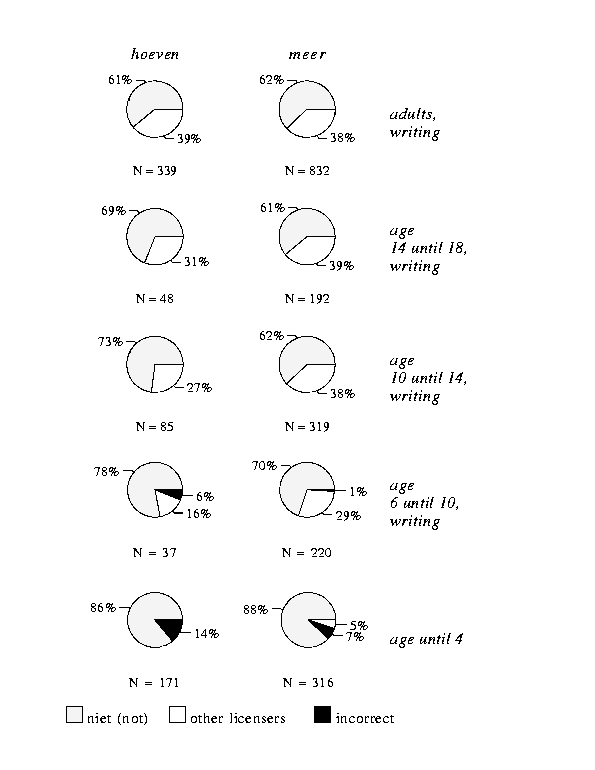
The gradual development towards more variety in licensing environments is presented in Figure 5.1 below, which shows patterns in the distribution of hoeven and meer in different age groups. The bottom and top row show the patterns found in the corpus of recorded child speech and a corpus of written adult Dutch, respectively (these data were presented earlier in Figure 3.1). In Figure 5.1, intermediate data from the written corpus of letters and essays are included, divided in time spans of four years: from age 6 until 10, 10 until 14, and 14 until 18. The five rows in this figure, read from the bottom to the top, present the gradual developmental progression in a nutshell.
Figure 5.1: Environments for hoeven and meer, different
age groups
Until the age of four, hoeven and meer are licensed by classical negation, niet (not), or occur in combination with pseudo-licensers. The portion of other licensers is extremely small; it makes up only 5% for meer and less than 1% in the case of hoeven. In essays of elementary school children from age 6 until 10, three notable changes have occurred in comparison to the youngest age group: hoeven and meer in non-licensing environments now have become very rare, the portion of niet (not) as a licenser is reduced, and a wider variety of correct licensers is used. In the data from 10- to 14-year-olds, these developments continue and the general distributive patterns now closely approach the adult model: hoeven and meer are no longer found in non-licensing environments and the portion of niet (not) is further reduced in favor of other correct licensers. The data from the 14- to 18-year-olds present no substantial changes but only the last small step towards an adult-like proportion of niet (not) to other licensers.
Up to Chapter 5 Table of
ContentsThe preceding sections have made it clear that the acquisition of NPIs is a protracted process. Although hoeven and meer already occur in the vocabulary of two year old children and start off correctly with a restricted distribution, it takes years before their distribution is in complete accordance with patterns that characterize the distribution of these expressions in adult discourse.
In the later years, this progression may not be too conspicuous, since it is primarily a process of expansion, in which no striking errors occur. One way to make the still ongoing development visible is by displaying general patterns in the distribution of NPIs in corpora of different age groups, as in Figure 5.1 above. Another way is to confront subjects with a number of sentences containing NPIs and to ask them whether they consider these to be correct or not. By asking judgments on the same set of sentences in different age groups, it should then be possible to note changes in answer patterns as age increases. The present section will discuss such an experiment, in which subjects were asked to judge sentences with hoeven in various licensing and non-licensing environments.
Up to Chapter 5 Table of
ContentsThe judgments were obtained by carrying out a paper-and-pencil test, in which subjects were given a written list of sentences and were asked to judge these by assigning a plus or minus to each sentence. They were instructed to base their judgments on whether the sentences were `good' or `bad'.
The subjects included 82 children, spread over four age groups, varying from 7 to 14 years old. There was also a group of 24 18- and 19-year-olds, representing the adult standard. Table 5.1 gives the exact group sizes, and the age means and ranges. Originally, 125 subjects participated in the experiment; 19 of these were excluded from the analysis due to incompletion of the test or because Dutch was not their native language.
| Age group | N | Age range | Mean age |
|---|---|---|---|
| 7- and 8-year-olds | 22 | 7;09 - 8;10 | 7;11 |
| 9- and 10-year-olds | 20 | 9;05 - 10;10 | 10;00 |
| 11- and 12-year-olds | 20 | 11;07 - 12;09 | 12;02 |
| 13- and 14-year-olds | 20 | 13;08 - 14;07 | 14;01 |
| 18- and 19-year-olds | 24 | not known | not known |
The test was administered during class-hours at an elementary school in Vriezenveen (the 7- to 11-year-olds), a high school in Groningen (the 13- and 14-year-olds), and the University of Groningen (the 18- and 19-year-olds).
Up to Chapter 5 Table of
ContentsThe test sentences included 18 different environments for hoeven, listed in Table 5.2 (in slightly different notations, so that they will be better distinguishable in the subsequent graphs presenting the results).
| legal | illegal | |
|---|---|---|
| niet (not) | counterparts of legal licensers | found in child speech |
| WEL (indeed) | ||
| geen (no, quant.) | *een (a) | CONTRAST |
| niks (nothing) | *alles (everything) | NOG (still) |
| nooit (never) | *altijd (always) | OOK (also) |
| alleen (only) | ||
| weinig (few) | *veel (much) | |
| niet alle (not all) | *alle (all) | |
| bijna niks (almost nothing) | *bijna alles (almost everything) | |
The environments for hoeven, fall into two main categories: legal and illegal environments. The legal category contains eight licensers which normally occur with hoeven in adult language. These include classical negation (niet), regular negations (geen, niks, nooit, alleen), minimal negations (weinig, niet alle), as well as a modified negative expression which falls outside the strict hierarchy based on entailment patterns (bijna niks). The illegal category is subdivided into six blatantly ungrammatical environments - to wit the affirmative counterparts of the licensers - and four environments in which hoeven was found to occur in children's speech, briefly indicated as wel (indeed), contrast, nog (still), and ook (also).
Wel (indeed) refers to test sentences expressing an explicit form of contrast, such as De deur hoeft wel op slot! (The door does need to be locked!). In order to approach the echoic contrast which in adult discourse is a prerequisite for such affirmative sentences with hoeven to be grammatical (cf. the examples given in Chapter 1), they were preceded by a corresponding negative sentence, in this particular example De deur hoeft niet op slot. (The door needs not to be locked.). Such negative/positive pairs, however, were not directly contrastive, as they in the test were separated from each other by two intermediate sentences. Strictly speaking, according to adult grammar, the echo thus is not direct and explicit enough for the wel-sentence to be grammatical. In children's spontaneous speech, however, the hoeven+wel combination sometimes does occur in utterances where there is no directly preceding negative utterance.
Contrast refers to test sentences expressing a yet more implicit contrast, such as Erik mag kiezen tussen een rode en een groene bal. Hij hoeft de rode. (Erik may choose between a red and a green ball. He needs the red one.). In such sentences, two alternatives are presented, and the choice for one of these carries the implicature that the other one is not needed or wanted.
Nog (still) refers to test sentences in which nog (still) has the negative implicature of nog maar (only/just), as in Het boek is bijna uit; Tom hoeft nog twee bladzijden te lezen. (Tom has almost finished the book. He needs still two pages to read.).
Finally, ook (also) refers to test sentences in which hoeven occurs together with ook (also), an illegal combination which was found both in spontaneous speech and as an ERIC response in the experiment with 3-year-olds (possibly functioning as a dummy pseudo-licensing element; cf. Note 5 in Chapter 4). An example of such a test sentence is Gerda gaat naar de winkel en Ineke hoeft er ook naar toe. (Gerda goes to the store and Ineke also needs to go.).
Questions with hoeven, although these do occur in children's spontaneous speech, were not included in the test sentences. It was expected that these, precisely by their interrogative character, might cause confusion in a grammaticality judgment task.
Each of the 18 environments occurred in three test sentences, making a total of 54 test sentences. These were alternated with 36 filler sentences, which contained verbs other than hoeven. Just like the test sentences, the fillers consisted of both grammatical and ungrammatical sentences. This was a built-in control to check whether judgments were made purely on the basis of grammaticality. An unusual judgment pattern for the filler items would be an indication that the pattern for the test sentences did not result from true grammaticality judgments either.
The test was administered in two sessions. In each session, the subjects judged 45 sentences; half of the hoeven sentences and half of the filler sentences. In order to make sure that all subjects, including those in the youngest age group, were able to read and understand the test, the sentences were constructed with Kohnstamm et al. (1981), the list of words teachers presume to be known by Dutch 6-year-olds, as a guideline.
Up to Chapter 5 Table of
ContentsWhen the ERIC task was piloted, it became clear that 7-year-olds are capable of giving direct grammaticality judgments (cf. section 3.11.1). In this light, the youngest age group in the present experiment, the 7- and 8-year-olds, should be able to judge the test sentences. The difference with the ERIC task, however, is that this is a written test, consisting of a considerably longer list of sentences, which the children had to judge all by themselves. When the test was administered, it became clear that it took the children in the youngest age group much longer to judge the sentences than in the older age groups. Also, when the results were scored, the youngest group showed a considerably higher average score of incorrect judgments on the filler items (e.g. rejections of grammatical fillers or acceptations of ungrammatical fillers), as indicated in the `Average fillers wrong' column in Table 5.3.
| Age group | Average fillers wrong | s | N subjects tested | N with group-internal criterion | N with group-external criterion |
|---|---|---|---|---|---|
| 7 and 8 | 6.5 | 3.7 | 22 | 22 | 11 |
| 9 and 10 | 1.6 | 1.3 | 20 | 20 | 20 |
| 11 and 12 | 1.1 | 1.0 | 20 | 20 | 20 |
| 13 and 14 | 0.6 | 0.8 | 20 | 20 | 20 |
| 18 and 19 | 0.6 | 0.8 | 24 | 24 | 24 |
There are two possible criteria for filtering out the subjects whose scores are not reliable enough to be presented as true grammaticality judgments on the environments for hoeven. One is a within-group criterion, in which individual scores of incorrectly judged fillers are allowed to fluctuate within two standard deviations from the average of incorrectly judged fillers in that age group. Application of this criterion would result in all age groups keeping their original size (cf. the `N with group-internal criterion' column in Table 5.3). With the relatively high score of incorrectly judged fillers in the youngest age group, however, this means that these subjects' judgments on the hoeven sentences should be viewed with reservation, as they are likely to contain an amount of noise comparable to the judgments given on the fillers.
The other possible criterion is absolute and applies to all subjects, regardless of their age: subjects who make more than a certain percentage of incorrect judgments on the fillers are excluded from the analysis. If the critical value is set on 10% (thus allowing a maximum of four out of 36 fillers to be incorrectly judged), then the youngest age group should be reduced to half its size (cf. the `N with group-external criterion' column in Table 5.3). The criteria make no difference for the size of the older age groups, as the incorrect filler scores in either way are well below the critical value.
In the following presentation of the results, the original group sizes will therefore be maintained for the older age groups. The results from the youngest age group, however, will be presented in two separate graphs, one with the group size based on the group- internal criterion, the other with the group size based on the group-external criterion.
Up to Chapter 5 Table of
ContentsThe results will be presented in graphs per age group, in which the percentages of acceptance for each environment are rank-ordered. In order to give a basis for comparison, graphs containing the judgments of ideal and actual adult speakers are presented first, in Figure 5.2 and Figure 5.3, respectively.
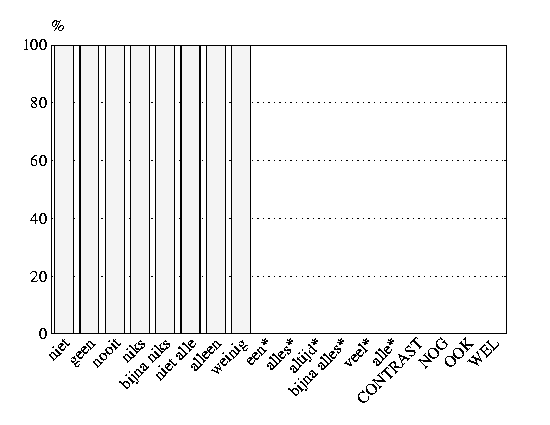
Ideally (cf. Figure 5.2 below), sentences with licensers would always be accepted (100% bars), whereas sentences with non-licensers would never be accepted (0% bars). This results in a general picture of a cliff, with a steep drop-off at the demarcation between licensers and non-licensers.
Figure 5.2: Acceptance percentages, ideal adult speaker
When Figure 5.2 is compared with Figure 5.3 below, which contains the results of the 18- and 19-year-olds, it is immediately clear that the ideal picture is approximated very closely by actual young adult judgments: sentences with licensers are accepted and sentences with non-licensers are firmly rejected. The only notable deviations from the ideal judgment pattern are that sentences with weinig (few) and alleen (only) are sometimes considered to be ungrammatical, whereas sentences with nog (still) in a few cases are accepted.
Figure 5.3: Acceptance percentages, 18- and 19-year-olds
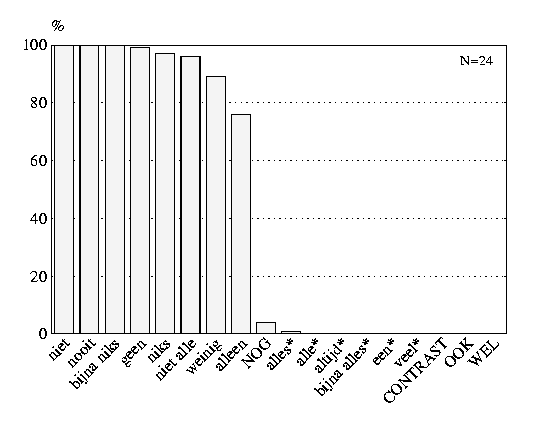
Figure 5.4 below contains the results of the oldest children, the 13- and 14-year-olds.
Figure 5.4: Acceptance percentages, 13- and 14-year-olds
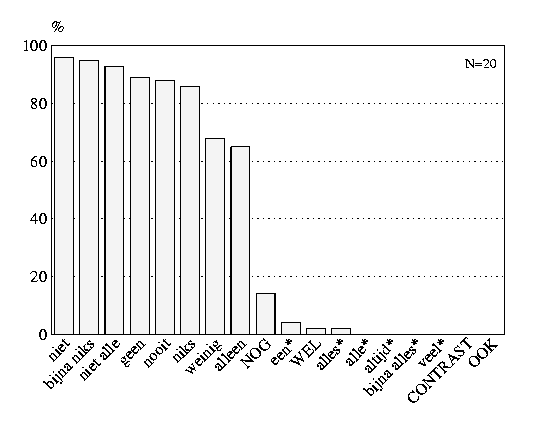
The 13- and 14-year-olds' judgments are quite adult-like: a clear drop-off line can be identified, which coincides with the demarcation between the adult licensers and non-licensers. The subjects in this age group thus make a clear distinction between what is grammatical and what not: sentences with non-licensers are rejected, whereas those with licensers are accepted. Again, in the group of licensers, judgments on sentences with weinig (few) and alleen (only) appear to be less stable, as these occupy a mid-position in the ranking. Also note that the pseudo-licensers cannot be identified as a separate group: nog (still) is at the head of the rank order of non-licensers, wel (indeed) is in the middle, while contrast and ook (also) are at the tail end. Apparently, for the subjects in this age group, the four pseudo-licensers do not exist as a group. It should be noted, however, that the pseudo-licenser nog (still) is not rejected as firmly as other non-licensers.
The results from the 11- and 12-year-olds (cf. Figure 5.5 below) are not quite as adult-like as those of the 13-and 14-year-olds, but still show the same general pattern.
Figure 5.5: Acceptance percentages, 11- and 12-year-olds
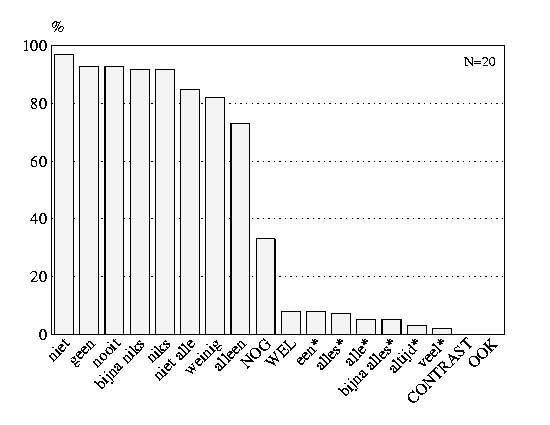
There is a clear drop-off, which coincides with the demarcation between licensers and non-licensers. The pseudo-licensers are not present as a group, and again nog (still) has an in-between position, together with weinig (few) and alleen (only).
In the graph of the 9- and 10-year-olds (cf. Figure 5.6 below), the cliff-like pattern is less clear. The general line more closely resembles a steep slope.
Figure 5.6: Acceptance percentages, 9- and 10-year-olds
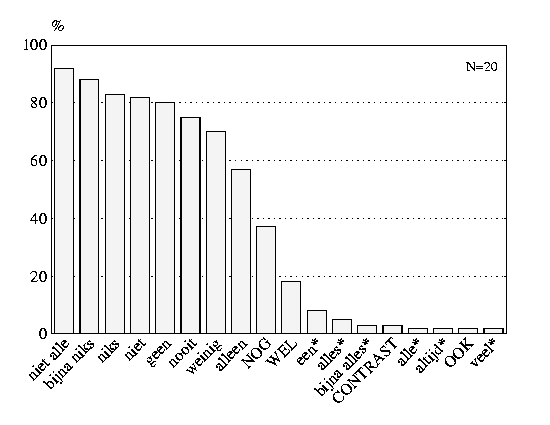
The distinction between licensers on the one hand and non-licensers on the other is not quite as pronounced as it is in the older age groups; there is a mid-area - containing weinig (few), alleen (only), nog (still) and wel (indeed) - in which the judgments are unstable. What is still the same, though, compared with the results from the older age groups, is that the pseudo-licensers as a group are not marked off from other non-licensers and that nog (still) is the least rejected of the non-licensers; in this age group, it is accepted 37% of the time.
The results from the youngest age group, the 7- and 8-year-olds, are presented in two graphs, for reasons pointed out in section 5.6.3. Figure 5.7 below shows the acceptance pattern of the 22 subjects whose score of incorrectly judged fillers is within two standard deviations from the average score in that group.
Figure 5.7: Acceptance percentages, 7- and 8-year-olds, group-internal criterion
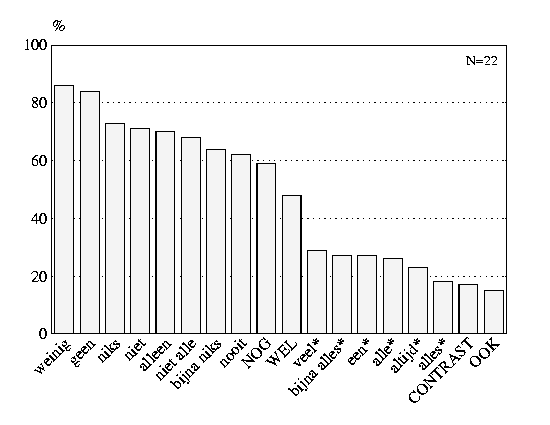
The general line that can be traced from licensers to non-licensers no longer resembles the adult, cliff-like pattern at all. Instead, there is a gradual slope. Apparently, the sharp distinction between licensers and non-licensers is not as clear for these 7 and 8 year old children. More often than the older children do they incorrectly reject the grammatical sentences and incorrectly accept the ungrammatical ones. Also notice that two of the four pseudo-licensers are often accepted. Sentences with nog (still) and wel (indeed) were assigned a plus 59% and 48% of the time, respectively.
The other graph, Figure 5.8 below, shows the judgment patterns of the 11 subjects in the 7- and 8-year-olds group who met the strict, age-independent criterion of maximally four incorrectly judged fillers. Presumably then, these subjects represent the 7- and 8-year-olds who feel confident giving grammaticality judgments in a written test.
Figure 5.8: Acceptance percentages, 7- and 8-year-olds, group-external criterion
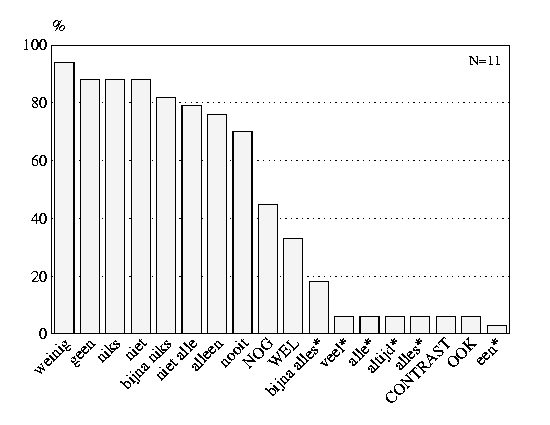
When this graph is compared to Figure 5.6, it is clear that the general acceptance pattern now is much more like the pattern shown by the 9- and 10-year-olds: the line from licensers to non-licensers is a steep slope, with a mid-area - including the pseudo-licensers nog (still) and wel (indeed) - where judgments seem to be unstable. Interestingly, however, when the rank-ordering of bars in Figure 5.8 is compared to that in Figure 5.7, it becomes clear that the various environments appear in basically the same ordering. Particularly noteworthy is the top-ranking of weinig (few), which in the graphs of the older age groups always occupies a mid-position. In Figure 5.8, the acceptance of weinig (few) is even higher than in Figure 5.7.
The similar rank-orderings in Figure 5.7 and Figure 5.8 mean that the 22 7- and 8-year-olds after all are a coherent group. The fact that Figure 5.8 shows a steep slope whereas Figure 5.7 shows a more gradual line, ranging from not that high (86%) to not that low (15%), must be attributed to the contribution of the 11 subjects who did not feel confident giving written grammaticality judgments. Their uncertainty with the task resulted in less determined judgments: they were less firm in accepting licensed sentences and were particularly hesitant to reject non-licensed sentences.
Up to Chapter 5 Table of
ContentsWhen the acceptance patterns in the different age groups are compared, it is clear that it takes a long time before the judgments are steady and in accordance with the adult standard. The youngest children in this experiment, the 7- and 8-year-olds, are not quite firm in making the distinction between grammatical and ungrammatical when faced with the hoeven sentences. In particular their judgments on sentences with the pseudo-licensers nog (still) and wel (indeed) are fuzzy. From the 7- and 8-year-olds' judgment pattern to that of the oldest age group in this study, the 13- and 14-year-olds, is quite a leap. The 13- and 14-year-olds are close to the adult standard as far as their judgments about the hoeven sentences are concerned. There is a clear and strict borderline between what is considered to be a correct environment for hoeven and what not. The two middle groups in this study, the 9- and 10-year-olds and the 11- and 12-year-olds, demonstrate that the differences between the oldest and youngest age groups are best described as representing gradual changes in their understanding of what exactly constitutes a correct licensing environment for hoeven.
The results on the sentences with pseudo-licensers show that the judgments gradually become more adult-like with increasing age. At the age of seven, the tolerance for implicit contrast and ook (also) is already fairly low. The tolerance for wel (indeed) and in particular nog (still), however, decreases only slowly. Even teenagers and young adults do not reject nog (still) as firmly as other non-licensers.
It should also be noted that the rank-ordering of the total variety of environments - including licensers as well as non-licensers - is not fixed over the different age groups; the bars representing different environments do change position. Importantly, however, such shifts occur only to a limited degree. All graphs display the same, basic ordering: licensers cluster on the left and non-licensers on the right. Never is the cluster of licensers intruded by a non-licenser, or does a licenser occupy a position among non-licensers. This means that in all age groups a basic division is made between grammatical and ungrammatical, thus between licensers and non-licensers.
Within this two-way split, there appears to be no internal clustering on the basis of shared entailment patterns of the different environments. For instance, the acceptance score on the classical negation niet (not) may be as high as that on the modified negative expression bijna niks (almost nothing), such that these two may be each other's neighbors in the graph.
There is, however, one cluster which is quite consistent in the different age groups: weinig (few), alleen (only), and nog (still). These three occupy a mid-position in the graphs (with the exception of Figure 5.7 and Figure 5.8, in which weinig (few) occupies a top position, as was noted above). Although weinig (few) and alleen (only) are always on the left hand side of the borderline between grammatical and ungrammatical (i.e. the acceptance scores are higher than 50%) and nog (still) is on the right hand side (again with the exception of Figure 5.7, in which nog (still) has crossed this borderline), their clustering in the middle indicates that the judgments are less stable for these environments. Rullmann et al. (to appear) conjectured that these unstable judgments might be induced by the fact that, for these expressions, the boundary between implications and presuppositions or implicatures is not too strict. If semantic aspects of meaning are mixed up with pragmatic ones, weinig (few) and alleen (only) could be miscategorized as non-licensers, and nog (still) as a licenser.
The general results from this paper-and-pencil test corroborate the conclusion which was made earlier in this chapter, that acquisition of the full range of licensers is a protracted process, which continues until the teenage years. Both the changing licensing patterns in Figure 5.1 and the changing judgment patterns in the experiment indicate that it takes years before children's early sensitivity to the restricted distribution of NPIs is completely unfolded and the confines of licensing are in accordance with adult grammar.
 On to `Summary and Conclusion'Up to general Table of Contents
 Back to previous chapter: `The Spontaneous Speech Data Revisited'