 Up to general Table of Contents
As illustrated by the corpus data in the previous chapter, the earliest utterances with NPIs suggest that very young children already do quite well: hoeven and meer have a restricted distribution and occur in a proper environment from the onset. In the light of the lack of negative evidence, such a restricted distribution is an advantageous starting point. A notable deviation from adult NPI use at this early age, however, is that there is no variety in the environments in which hoeven and meer occur in the children's speech; they only appear in utterances with the classical negation niet (not).
In this chapter, the same corpus of spontaneous speech will be used, now with the focus on the later data, until the end of the recordings at the age of about four. It will be shown that the picture changes towards more variety in the environments in which hoeven and meer appear. These changes, however, are not always for the better. Hoeven and meer now also start to occur in sentences in which no correct licenser is present. At the same time, niet (not) is still pre-eminently the licenser for hoeven and meer in correct utterances.
These observations appear to represent a discrepancy. On the one hand, hoeven and meer are used correctly but very narrowly restricted. On the other hand, there is some incorrect usage, where these NPIs apparently are used too broadly, in non-licensing environments.
On the basis of these observations, the question arises as to what understanding children of this age have of the licensing conditions on NPIs. This question will be systematically investigated in an experiment with three year old children which indirectly elicits grammaticality judgments of both correct and incorrect utterances with the NPI hoeven. In this experiment, several hypotheses are put to the test: three hypotheses stating what isolated patterns in children's NPI use on a superficial level seem to represent, and a fourth, alternative one, which states that there is a sensitivity to the restrictions on NPIs underlying the apparent incompatibilities which appear on the surface. The experimental results do not provide support for any of the superficial analyses of the spontaneous speech data, and it is concluded that the alternative explanation is the most plausible one.
Up to Chapter
3 Table of
ContentsFrom the age of two, NPIs occur more generally throughout the corpus (cf. Table 2.3); at first still in very simple utterances, but within a few months later also in utterances which exceed the three-word level. Several examples from this period were already discussed in the preceding chapter, when the question was dealt with whether hoef(t) nie(t) and nie(t) meer possibly function as unanalyzed negative units. These examples showed that, from the age of two, both hoeven and meer are treated as individual expressions, separate from the negation niet (not). Also, a tendency could be noted towards a syntactically more varied use than just the direct combinations hoef(t) nie(t) and nie(t) meer which characterized the very onset of these NPIs. This pattern continues and is consolidated in later data from the age of about two and a half. See for instance the following examples:
| (1) |
nou zitte(n)
mense(n) niet in e
stad meer.
(2;06.27) now sit people not in e city anymore. |
| (2) |
nee dat kan niet vast meer. (3;00.20) no that can not tied anymore. |
| (3) | nee, hij kan niet hier staan meer. (3;01.04) no, he can not here stand anymore. |
| (4) |
die um # hoeven niet in
[/] niet in de la. (2;07.28) those-ones ehm # need not in [/] not in the drawer. |
| (5) |
nee die hoef ik niet. (2;09.26) no that-one need I not. |
| (6) |
allemaal hoef ik niet hebben. (2;10.04) all-of-them need I not have. |
Examples (1) - (3) show that meer no longer exclusively occurs in the immediate company of niet (not), but sometimes is detached from it by an intervening adverbial phrase. In the other examples, hoeven is correctly used as a verb: there is agreement between subject and verb, as in (4), and inversion in topicalized sentences, as in (5) and (6).
Now that the children's utterances have a more elaborated syntactic structure, the question arises as to whether this results in more variety of the environments in which hoeven and meer appear. The data make it clear that this is indeed the case; different patterns of usage can now be distinguished.
A first notable pattern is that hoeven and meer now sometimes occur in sentences in which no licenser is present. Common in these ungrammatical utterances is that a correct licenser is lacking, but closer observation of the context in which these utterances appear shows that they are not a uniform phenomenon. On the basis of their meaning, they can be divided in two categories. One category consists of utterances with a negative meaning, although negation is not expressed in the sentence itself. These utterances will be discussed in the next section, 3.3. The other category consists of utterances without a correct licenser and with an affirmative meaning. These will be discussed in section 3.4. Apart from these ungrammatical utterances, there is continuation of the pattern of correct but very restricted licensing, characteristic from the onset of these NPIs. When hoeven and meer are used correctly, it is still in only one specific licensing environment, the classical negation niet (not). This pattern will be discussed further in section 3.5.
Up to Chapter 3 Table
of
ContentsThe following examples from the corpus show utterances which are incorrect from the point of view of adult speech, since they contain meer and hoeven in a non-licensing environment:
| (7) |
heleboel meer # heleboel sneeuw
# nee! (2;08.05) very-much anymore # very-much snow # no! |
| (8) |
ik hoef pit in # nee. (2;09.26) I need nut in # no. |
In both examples, the NPI is not licensed, since it occurs in a sentence which strictly speaking is affirmative, in that there is no negation present within the sentence. These utterances, however, are not meant to have an affirmative meaning, as is clear from the contexts in which they appear:
Context of (7):| adult: |
had je 'n sneeuwpop gemaakt? `did you make a snow man?' |
| child: | heleboel meer # heleboel sneeuw # nee! [1] very-much anymore # very-much snow # no! |
| adult: |
nee, heleboel sneeuw is weg. sneeuw is allemaal weg. `no, all the snow is gone. the snow is all gone.' |
| child: |
ik hoef pit in # nee. I need nut in # no. |
| adult: |
wat? what? |
| child: |
niet e pit in. not e nut in. |
| adult: |
zitten geen pitten in, nee. `there are no nuts in it, no.' |
Both utterances contain a syntactically overt marker which expresses the negative meaning: the negative morpheme nee (no). In adult Dutch, nee (no) functions as an anaphoric negation, referring to an earlier question or proposition. The earlier proposition may be either negative or affirmative. In the first case, nee (no) expresses agreement with the negative character of the earlier proposition, as for instance in A: Jan is niet lang. B: Nee, dat is hij niet. (A: John isn't tall. B: No, he isn't.). In the latter case, nee (no) expresses disagreement with the affirmative character of the earlier proposition, as for instance in A: Jan is lang. B: Nee, dat is hij niet[!]. (A: John is tall. B: No, he is not[!].). Anaphoric nee (no) may also occur as an unstressed affix to an earlier negative proposition uttered by the same speaker, as for instance in Jan is niet lang, nee. (John isn't tall, no.). The way in which nee (no) appears in examples (7) and (8), however, as an affix to an affir-mative proposition uttered by the same speaker, is not allowed in adult grammar. Anaphoric nee (no) cannot refer back to earlier affirmative propositions.
The ungrammaticality of examples (7) and (8) is not only a matter of incorrect reference, though. Nee (no), although it certainly functions to express negative meaning, is in itself not a correct licensing environment for NPIs. This makes examples like (7) and (8) all the more interesting, since it indicates that these incorrect utterances are unlikely to represent simple overgeneralizations of NPIs to non-licensing environments. The fact that hoeven and meer appear in an environment which at least has a flavor of licensing, in terms of a negative meaning, may indicate an underlying attempt to adhere to some kind of restriction on the distribution of these expressions.
A second example of an NPI occurring in a non-licensing environment with a negative meaning - but now with an even less obvious negation marker - is the following utterance:
| (9) |
hoef papa fiets! [=! vigorously shaking her head]
(2;03.11) need daddy bicycle! |
At first sight, hoeven occurs unlicensed, in what seems to be an affirmative sentence. But again, further investigation of the context shows that the meaning of this utterance is negative. This time, a negation marker is hidden in the paralinguistic context: this affirmative sentence is accompanied by a headshake. Thus, the child meant to say that she did not want to sit on her dad's bike.
Like anaphoric negation, headshaking cannot function as a licenser for NPIs. Headshaking can be regarded as even one step further away from correct licensing than anaphoric negation, since the licensing conditions on NPIs always have to be met in syntactic structure. While nee (no) is a linguistic means of expressing a negative meaning, headshaking is not a syntactically overt expression. Headshaking, as a non-verbal, deictic negator, can at best function to corroborate or stress the meaning of an utterance which is already negative. It cannot, however, be used as a sentence negation on its own.
What nee (no) and deictic headshaking have in common in the above examples is that they both are functional markers of negative meaning. This is an indication that utterances like (7), (8), and (9) do not represent simple overgeneralizations of NPIs to non-licensing environments. This matter will be taken up again in section 3.7.
A third set of examples also falls under the heading of the category `no correct licenser; negative meaning'. In these utterances, meer and hoeven again occur in sentences which from a purely linguistic point of view are affirmative. Some examples are given below:
| (10) |
ja, doet e meer. (2;01.08) yes, works e anymore. |
| (11) |
ik hoef wijkoek. (2;04.28) I need honeycake. |
| (12) |
ik vind eend e meer. (2;11.26) I find duck e anymore. |
When the context of these utterances is taken into account, it again becomes clear that their meanings must be negative:
Context of (10):| child: |
(ka)pot. kaput. |
| adult: |
kapot. kaput. |
| child: |
ja, doet e meer. yes, works e anymore. |
| adult: |
hij doet het niet meer. `it doesn't work anymore.' |
| child: |
nee. no. |
| child: |
ik hoef wijkoek. I need honeycake. |
| adult: |
wil je nog 'n stukje ontbijtkoek? `do you want another piece of honeycake?' |
| child: |
nee. no. |
| adult: |
niet? nou dan niet. `don't you? ok, that's fine with me.' |
| adult: |
die duikt met z'n koppie onder water, he? en de kindjes zwemmen zo tussen de eendjes door. `that duck takes a header, huh? and the children swim between the ducks.' |
| child: |
ja. hee. kijk. ik vind eend e meer. yes. hey. look. I find duck e anymore. |
| adult: |
nee. no. |
This time, no linguistically affixed negative morpheme, or negation in the guise of deictic headshaking can be detected. In these utterances, the discourse provides the only clue to a negative meaning. It looks as if negation here has simply been omitted. Although a negative meaning is clearly intended, it is not expressed in the sentence.
In principle, this last set of utterances shows the same characteristics as the earlier examples - that is, expressing a negative meaning but lacking a correct licenser. In practice, however, they must be regarded as slightly different, since a negation marker is now completely absent. Due to their obviously negative meaning, however, it is again unlikely that these utterances represent an overgeneralized distribution of NPIs. If the distribution of NPIs really was overgeneralized, then we would expect these expressions to occur in straightforwardly affirmative sentences. The utterances discussed in this section, however, have the common characteristic that they combine an affirmative structure with a negative meaning. This negative meaning becomes clear either from the discourse, as in (10) - (12), or from an affixed nee (no), as in (7) and (8), or a deictic headshake, as in (9). In adult language, nee (no) and headshaking are typically used to accompany utterances which are already negative. This leaves us with the impression that there might be something else in these child utterances which causes their negative meaning; a possibility is that the NPIs themselves function to express negation. In that view, these utterances might represent the opposite of an overgeneralized distribution - that is, a much too narrow use of NPIs. If the distribution of NPIs is so narrowly defined that negation becomes inherent in their meaning, then a separate negation marker may become redundant and therefore need not be expressed.
Up to Chapter 3 Table
of
ContentsThe incorrect utterances to be discussed in this section are also characterized by the absence of a correct licenser, just as those reviewed in the previous section. But, on the basis of these utterances' meaning, the errors must be distinguished as being of a different type. See the following list of examples:
| (13) |
op hoeft # huh? dis-is
opp(l)akke(n
)? (2;03.04) on needs # huh? this-is stick-on? |
| (14) |
ik hoef wel. (2;05.01) I need indeed. |
| (15) |
hoeft er op? (2;06.11) need there on? |
| (16) |
Kim hoeft ook dit he? (2;07.30) Kim needs also this huh? |
| (17) |
die[!]
# hoeven
wij, die[!] hoeven wij! (2;11.03) that-one[!] # need we, that-one[!] need we! |
| (18) |
ik hoef van jou zachte 'n. (2;11.20) I need from you soft one. |
| (19) |
hoef jij ook? (2;11.20) need you also? |
| (20) |
ik hoef drinken[!]. (3;01.13) I need (something to) drink[!]. |
| (21) |
nee, hoeft wel. (3;06.03) no, needs indeed. |
At first sight, these utterances seem to display the same error as those discussed in the previous section: they lack a licenser for the NPI. There is one remarkable difference, though: the above utterances appear to have an affirmative meaning.[2] No negative meaning, expressed by an affixed negation marker or headshaking can be detected. Neither does the context reveal any hidden negative meaning. On the contrary, the context makes it clear that if hoeven in these utterances were replaced by a non-polarity modal verb like willen (want) or moeten (must), the meaning would be left intact:
Up to Chapter 3 Table of
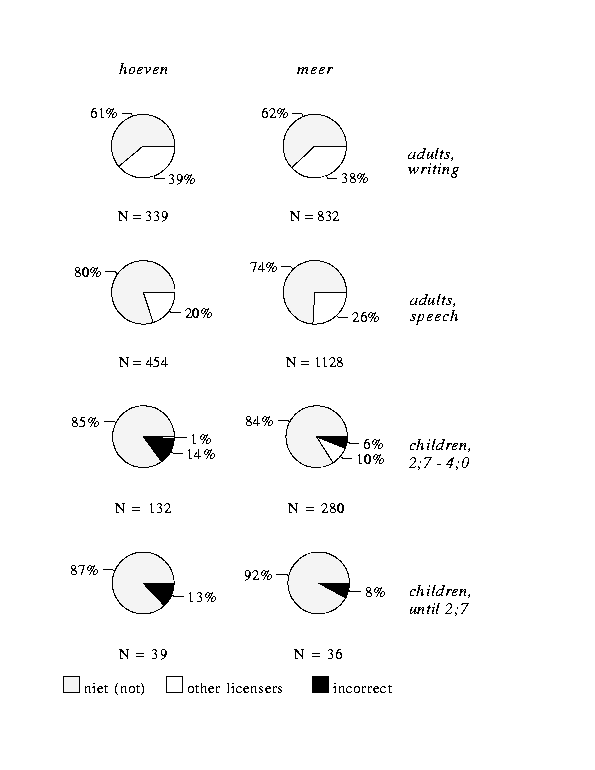
ContentsOn the total amount of occurrences of NPIs until the age of four, ungrammatical utterances of the types discussed in the preceding two sections are relatively few in number. The main part of the children's utterances with hoeven and meer is properly licensed. Characteristic of these correct utterances is that licensing occurs almost exclusively by means of the classical negation niet (not). Thus, the pattern of occurrence which was found from the very onset continues at a later age. This one-sided use of hoeven and meer in the children's speech, as opposed to varied use of licensers in adult language, is visualized in Figure 3.1 below.
Figure 3.1: Environments for hoeven and meer, different age groups
The two pie charts on the fourth row show the proportion of different environments for hoeven and meer in the children's speech until the age of two and a half. The contrast with adult NPI use is immediately clear. The children's pattern of usage is extremely one-sided, even when it is seen in perspective with the adults' preference for niet (not) as a licenser. Apart from some variety in environments caused by ungrammatical utterances, niet (not) is the only legal licenser used in the children's early speech.
The two pie charts on the third row, displaying the pattern of usage of hoeven and meer from the age of two and a half until the end of the recordings at about the age of four, show that there is only a very slow progression towards a more varied use of licensers. At this age, niet (not) as a licenser has lost only a little ground, compared to earlier speech. Although other possible licensers, such as niks (nothing) and geen (no), are present elsewhere in the children's speech, they are only very sporadically used as licensers for hoeven and meer. [3] This one-sided distribution is especially remarkable in the case of hoeven: out of a total of 171 occurrences until the age of four, only two utterances were found in which hoeven occurred in an other licensing environment than niet (not).
Up to Chapter 3 Table of
ContentsThe preceding sections uncovered three characterizing patterns in the children's utterances with hoeven and meer. These are summarized and repeated below:
The crucial question to be investigated now is what these errors might represent: should they be regarded as a step forward, as a first attempt towards expansion of NPI environments, or do they mark backsliding, meaning that the children after all were not able to steer away from the trap of overgeneralization?
In the first case - errors as marking a step forward - we might see a parallel with a typical pattern in the acquisition of inflectional paradigms (Bowerman 1982). Children first use inflections, both regular and irregular, with remarkable accuracy (for example: shoes, feet; walked, broke). At a later age, errors start to occur: irregular forms which used to be correct in earlier speech are now overgeneralized, resulting in errors like foots and breaked. In the acquisition of inflections, such errors are actually considered as a development for the better, since they mark a transition from lexical learning to rule-governed learning.
In the latter case - errors as indicators of overgeneralized usage - the `no negative evidence problem' (cf. section 1.7.3) is looming large. If hoeven and meer are overgeneralized, thus being used according to their syntactic properties alone, then the question is how children, in the absence of evidence about what is not grammatical, can unlearn this too broad usage and discover that the distribution of NPIs is more restricted.
Up to Chapter 3 Table of
ContentsBefore the possible underlying causes for the spontaneous speech errors are looked at in more detail, another option will be considered first, to wit that the children's ungrammatical utterances with NPIs might be due to mere performance factors. If this were the case, then the errors would no longer represent counter-evidence to a conservative acquisition strategy, which in turn would make it unnecessary to investigate the question of how children recover from a too broad use of NPIs.
There are several indications in the data against an explanation in terms of performance factors. If the errors occurred for mere accidental performance reasons, they would have been expected to occur only rarely. If we look back at the two bottom rows in Figure 3.1, however, it becomes clear that the errors in the children's speech are not just a marginal phenomenon. Ungrammatical utterances constitute a substantial proportion of the child data, with percentages ranging from 6 to 14. On the average, the errors make up 10% of all recorded utterances with hoeven and meer in the children's speech until the age of about four.
Also, if the variety of performance factors - such as lack of attention, interruptions, and false starts - were responsible for the errors in the children's speech, then we would have expected this to result in a similarly erratic pattern of ungrammatical utterances. The data show, however, that this is not the case. The ungrammatical utterances in the children's speech deviate in a systematic way from adult language; they can be divided into two subcategories, on the basis of common characteristics (cf. sections 3.3 and 3.4). Moreover, Figure 3.1 shows that the errors persist over different ages. This makes it very unlikely that the ungrammatical utterances occur just by mere accident, and indicates that they represent a fundamental pattern. Another significant factor is that the errors do not occur in the data of only one particular child, but instead appear generally throughout the corpus, and are a recurrent pattern across different children. [4]
Not only do the errors persist over age and across different children, but also across different data collections. The errors which were found to occur in the corpus of recorded child speech are independently documented in diary notes. Firstly, diaries report of utterances which show the same characteristics as error pattern II found in the recorded speech - that is, utterances with a negative meaning in which no correct expression is present to license the NPI, such as the following:
| (22) |
nee meer ete(n).
nie(t) meer. nee meer. nee
xxx meer. (2;00.03) no (non-quant.)[5] anymore eat. no(t) anymore. no (non-quant.) anymore. no (non-quant.) xxx anymore. [6] |
| (23) |
nou-ze-meer. (2;02.25; with the remark that this often occurs, during several months) now-`are-there'-anymore. |
| (24) |
ik heb nee stoel meer. (3;01.17) I have no (non-quant.) chair anymore. |
Also, there are examples in diary notes which correspond to error pattern III in the recorded speech - that is, unlicensed utterances in which hoeven has an affirmative meaning. Some examples are given below:
| (25) |
deke(n)
(h)oef je niet,
kete(l)
(h)oef je wel. (3
years) blanket need you not, kettle need you indeed. |
| (26) |
ik hoef nog niet naar bed, ik hoef nog eten. (3;06.03) I need yet not to bed, I need still food/eat. |
| (27) |
hoef jij nou? rijst en boontjes? ikke niet. ik ga ijs eten met Sarah. (3;09.06) need you now? rice and beans? I not. I go ice-cream eat with Sarah. |
The fact that the error patterns found in the recorded speech are also documented in the diary notes is another indication that they represent a deviant pattern of NPI use in early child speech and should be taken seriously.
By the way, the diary data not only report of incorrect use of NPIs; also the conspicuous pattern in correct utterances - the very restricted licensing by means of niet (not) - is mentioned on several occasions. For instance, in one diary it is noted that hoef e niet is often used around the age of two. In the data of another child, it is noted that at the age of 2;03 hoef niet frequently occurs, and somewhat later, at the age of 2;09, that hoef niet is used as a `standard denial'.
Up to Chapter 3 Table of
ContentsSo far, the three characterizing patterns in children's early NPI use have been presented one by one, more or less in isolation from each other. When the focus of attention is shifted towards the fact that these patterns co-occur in the children's speech, they appear to represent discrepancies in various ways. Firstly, correct utterances occur at the same time as incorrect utterances, corresponding to two diametrically opposed patterns. On the one hand, hoeven and meer are used correctly but too narrowly, in combination with niet (not) only. On the other hand, examples occur in which hoeven and meer appear to be overextended to non-licensing environments. Secondly, there appears to be an internal contradiction in the two categories of ungrammatical utterances, in terms of their opposed meanings. Whereas one category is characterized by utterances with an affirmative meaning, the other category consists of utterances with a clear negative meaning.[7]
Attempts to give a unified account of the data, going by what these observations on a superficial view seem to represent, all run aground (cf. Table 3.1).
| spontaneous speech pattern | possible analysis | incompatible with | |
|---|---|---|---|
| I | correct utterances with a very restricted distribution (cf. section 3.5) | hoeven and meer can only occur in combination with niet | II and III |
| II | incorrect utterances with a negative meaning (cf. section 3.3) | negation is redundant,
since hoeven and meer have an inherent negative meaning | I and III |
| III | incorrect utterances with an affirmative meaning (cf. section 3.4) | there are no
specific restrictions on the distribution of hoeven and meer | II |
Taking the most frequently occurring Pattern I as a starting point - the correct but stereotypic distribution of hoeven and meer, with niet (not) as a licenser - this could possibly mean that at this age, the restrictions on NPIs are very narrowly defined, such that they can only combine with the classical negation niet (not). Such a view, however, is incompatible with the two error patterns II and III. If hoeven and meer were strictly limited to the presence of niet (not), why then do they sometimes appear in structurally affirmative utterances? On the other hand, the analyses of the error patterns II and III also appear to be incompatible with each other. Whereas utterances of Pattern II are negative in meaning but not in form, utterances of Pattern III are affirmative both in form and meaning. As was pointed out in 3.3, it could be that the utterances without a licenser and with a negative meaning, Pattern II, might in fact represent a too narrow use of NPIs, in which a licenser is not at all needed. The meaning of the NPIs themselves could be so negative that negation becomes redundant. Such an analysis, however, is incompatible with Pattern I: if NPIs in the children's grammar are inherently negative expressions, why then are they so often used together with niet (not)? Also, this analysis would be in flat contradiction with the analysis of the other type of error, Pattern III, in which utterances without a negation clearly express an affirmative meaning. This latter pattern, III, in principle might look like overgeneralized usage of NPIs. In that sense, it is not in conflict with the co-occurring Pattern I: if NPIs are overgeneralized and used according to their syntactic properties alone, they should indeed be allowed to appear in both affirmative (Pattern III) and negative (Pattern I) utterances. Such an analysis, however, is incompatible with utterances of Pattern II, which apparently can do without sentential negation to express a negative meaning.
Up to Chapter 3 Table
of ContentsAs these attempts to interpret the spontaneous speech data are incompatible with each other, an alternative explanation for these co-occurring patterns is called for, an underlying developmental progression which can reconcile the discrepancies which appear on the surface. As was pointed out already in the discussion of the error pattern in section 3.3, there are indications that the spontaneous speech data do not merely present us with just two immediately opposed categories of grammatical and ungrammatical utterances with NPIs, but that the distinction might in fact be more subtle, as to include an intermediate category of what could be dubbed `semi-grammatical' use of NPIs - that is, utterances which from an adult point of view are incorrect, but which might represent an attempt to adhere to licensing in child speech. Such utterances could provide a clue to an alternative explanation for the spontaneous speech data, that children are sensitive to the restrictions on NPIs from the onset, but that errors do occur since their understanding of correct licensing is still in development. In this view, the errors in the children's spontaneous speech are to be regarded as representations of some preliminary way of licensing.
This possible analysis has to be examined in more depth, since it has important consequences for the way in which the further investigation of NPI acquisition is organized. If there is support for this analysis, then the issue which was formulated earlier in section 3.6 - how does the acquisition of NPIs continue from here, and how do children get over these errors? - would be put in a totally different perspective. If the children's errors with NPIs indeed are representations of an intermediate stage in the acquisition of licensing, then the focus of attention in further investigations would shift from the question of how children retreat from errors in the absence of negative evidence, to the question of how children come to know what the characteristics of correct licensers are.
Up to Chapter 3 Table of
ContentsAs long as there is no additional evidence in support of the `licensing-in-development' explanation, the spontaneous speech data do not surpass the status of mere indications and do not constitute conclusive evidence. Therefore, the viability of this explanation will be compared with that of the other three attempts to interpret the spontaneous speech data, in a controlled, experimental setting. When the three incompatible analyses cannot be supported by experimental evidence, the `licensing-in-development' analysis gains more support as being the most plausible explanation for the spontaneous speech data. The comparison of these analyses boils down to an investigation of the basic issue whether and to what degree young children are sensitive to the restrictions on NPIs. What, in child grammar, counts as a proper environment for NPIs?
In order to make the different analyses suited for experimental investigation, they have to be translated into falsifiable hypotheses about children's knowledge of the distribution of NPIs. Meer will be excluded from these hypotheses, because its homonymy and possible ambiguity between a polarity and a non-polarity reading poses severe methodological problems. Therefore, the four hypotheses are formulated with specific reference to hoeven:
In order to test these hypotheses in an experimental setting, two types of responses have to be elicited from the subjects: grammaticality judgments and meaning assignments. Moreover, these responses are needed for a range of test items: grammatical sentences, in which hoeven occurs with a variety of licensers, as well as ungrammatical sentences, in which hoeven is not licensed.
Up to Chapter 3 Table of ContentsIn order to meet these requirements - grammaticality judgments and meaning assignments - a composite experimental task was created, in collaboration with Charlotte Koster (Van der Wal and Koster 1994; Koster and Van der Wal 1996), consisting of the Elicited Reproduction in Context task (ERIC, for short) in combination with an Acting Out task. The ERIC task was designed with special intent to elicit grammaticality judgments in a natural manner from young children (as the hypotheses to be investigated are based on patterns in the spontaneous speech of children until the age of about four). The ERIC response is paired with an Acting Out response, as an assessment of meaning assignment. This combination of tasks is illustrated below:
The child and two experimenters sit at a table. There is a box with toys and pictures. A Bert and an Ernie doll, known by all children from Sesamestreet, are also on the table. As one experimenter holds the doll of Bert, the other experimenter tells the child a short story of approximately three sentences, for instance:
Then the experimenter holding Bert says the test sentence (which is, in this particular example, ungrammatical since hoeven is not licensed):
*Ik hoef vandaag naar school te fietsen.
`I need to bike to school today.'
The child is told to join in the storytelling by repeating what Bert has said (the ERIC response) and then to show what Bert will do, with the help of toys or pictures (the Acting Out response).
The ERIC task is based partially on the Elicited Imitation task for children (Corrigan 1982; Maratsos 1983; Lust et al. 1986) and the Shadowing task for adults (Marslen-Wilson 1985). The assumption behind the ERIC task is that children will reproduce sentences in a way that fits their grammar. What the children are asked to do in this experiment is different from standard Elicited Imitation in that
Standard Elicited Imitation - that is, a direct request for a subject to repeat stimulus sentences - is a controversial technique in language acquisition research, as it is sometimes assumed to represent an unnatural and not a meaningful task (Corrigan 1982; Maratsos 1983; Lust et al. 1986). Therefore, it has been argued, children might be inclined to simply parrot the stimulus sentences without processing them. This drawback is obviated in the ERIC - Acting Out task combination, in which the child's attention is drawn away from a straightforward imitation instruction. Interestingly, this specific combination of tasks can only successfully bypass the problem of passive copying when the subjects are very young, as became clear from pilot testing with children of different ages. This matter will be discussed further in section 3.11.
Via the ERIC response the child's determination of acceptability is measured by his tendency to replicate or change the original stimulus sentence. Any changes made during reproduction give additional valuable information about where the grammatical shoe pinches, so to speak. For example, in the story - test sentence pair illustrated above, with the ungrammatical test sentence *Ik hoef vandaag naar school te fietsen (I need to bike to school today), the child can
The child's Acting Out task in the above test item is to choose between two pictures: one of Bert bicycling and one of Bert walking, corresponding to an affirmative or negative meaning of the test sentence. This Acting Out response, in combination with the ERIC response, gives the information necessary to interpret the child's understanding of hoeven. If the child leaves the test sentence intact in the ERIC response and chooses the picture of Bert walking, then hoeven appears to be an implicit negative verb. Another possibility is that the child gives an exact repetition of the test sentence, and chooses the picture of Bert biking. In that case, there is support for the hypothesis that hoeven is just a regular verb. If the child, however, corrects the sentence in the ERIC response, either by exchanging hoeven for another verb or by inserting a licenser, and the sentence is acted out accordingly, this is seen as evidence that the child treats hoeven as an NPI.
Up to Chapter 3 Table of
ContentsThe test included thirty story - sentence pairs. Fifteen of these were test items. The remaining fifteen were unrelated filler pairs, which were interchanged with the test items. The test items can be divided in sentences which from an adult point of view are grammatical or ungrammatical. See Table 3.2:
| fillers | test sentences | |
|---|---|---|
| 15 | 15 | |
| grammatical | ungrammatical | |
| alleen (only) 3 | licenser absent 6 | |
| geen (no, quant.) 3 | ||
| niet (not)3 | ||
There were three each of the grammatical types in which hoeven is licensed by alleen (only), as in example (28), geen (no, quant.), as in (29), and niet (not), as in (30). There were also six ungrammatical test sentences, in which hoeven appeared without any proper licenser, as for instance in (31):
| (28) | hoeven+alleen |
|
Ik hoef van jou alleen de gele te hebben. I need from you only the yellow to have. `I need only the yellow one from you.' | |
| (29) | hoeven+geen |
|
Van de juf hoef ik geen rood potlood te slijpen. Of the teacher need I no (quant.) red pencil to sharpen. `The teacher says I don't have to sharpen the red pencil.' | |
| (30) | hoeven+niet |
|
Ik hoef de gele viltstift niet. I need the yellow marker not. `I don't need the yellow marker.' | |
| (31) | *hoeven |
|
Ik hoef vandaag naar school te fietsen. I need today to school to bike. `I need to bike to school today.' |
There were two reasons for choosing alleen (only), geen (no, quant.), and niet (not) as licensers in the grammatical test sentences. Firstly, they reflect the typical usage of hoeven, since they are the most commonly used licensers for hoeven in adult speech (the percentages in the corpus of adult written speech are niet (not) 61%, geen (no, quant.) 12%, and alleen (only) 6%). Secondly, these expressions are known and used already by young children. The occurrence of alleen (only), geen (no, quant.), and niet (not) was checked in the corpus of recorded child speech, and it was found that they all have appeared and are correctly used before the age of three, as opposed to other possible licensers, such as niemand (no one), weinig (few), and zonder (without), which appear only later.
Up to Chapter 3 Table of
ContentsThe stories preceding the grammatical test sentences - such as (28), (29), and (30) - functioned as an experimental variable, by introducing a bias away from the test sentence interpretation. For example, test sentence (30) above - Ik hoef de gele viltstift niet (I need the yellow marker not) - was paired with a story about Bert wanting to draw a big, beautiful sun and having to choose a marker for this task from a trio of yellow, green, and purple markers. Given this story context, Bert's decision not to take the yellow marker is strange. The motivation behind this counterbias in the licensed test sentences was to investigate whether the children would be able to adhere to the proper interpretation of the licenser in the test sentence, and to resist the information in the preceding context. By including this counterbias, an opportunity was created for the subjects to let pragmatic considerations prevail over considerations of grammaticality, and to violate the licensing condition on hoeven: when there is a clash between context and test sentence, the ERIC task provides an occasion to harmonize the two by making a minimal word change to the test sentence by leaving out the licenser, thus changing it into an affirmative utterance. This would then result in a - for adults - ungrammatical, unlicensed sentence: *Ik hoef de gele viltstift (I need the yellow marker). Of course, this is not the only possibility the subjects have to deal with the bias; they might as well change the verb or the object in these sentences, or just leave the test sentence intact in the ERIC response, but act out the interpretation which is in accordance with the story bias. In the latter case, there would be a conflict between ERIC and Acting Out responses: the subject says one thing but acts out another. This matter will be taken up again in the discussion of the results (section 3.13.2).
The ungrammatical test sentences, such as (31), did not have any story bias manipulation. The preceding stories here were strictly neutral, for instance as the story presented above. Since one of the goals of the experiment was to investigate whether hoeven might be an implicit negative verb or just a regular modal verb, a positive or negative story bias would only be a complicating factor.
Up to Chapter 3 Table of ContentsThe ERIC - Acting Out task was designed with the intention to elicit, in an indirect manner, grammaticality judgments and meaning assignments from children. A first condition for this task combination to have this effect is that the subjects to be tested unpremeditatedly take part in the test as a game, so as to draw their attention away from dutiful imitations of the stimulus sentences, and to allow for a meaningful sequence of listening, reproducing, and acting out: hear the story - what did Bert say? - so, what does Bert do? As the task was new, we had to find out first in which age group the ERIC - Acting Out task combination was feasible. Therefore, the test was piloted at the Buitenschoolse Opvang (BSO) in Haren, an after-school activity center attended by children of different ages. This piloting gave valuable information about children's metalinguistic knowledge and their ability to give grammaticality judgments at different ages.
Up to Chapter 3 Table of
ContentsThe oldest subjects we tested were three seven-year-olds. They readily participated in the test, were interested to hear the stories and to act them out. It soon appeared, however, that the detour via the ERIC task was not necessary in order to obtain grammaticality judgments from these children, since they came up with direct and rather explicit grammaticality judgments. They repeated and acted out the grammatical test sentences without much further ado, but the ungrammatical, unlicensed sentences provoked confusion and at times rather fierce reactions. These sentences were deliberately corrected by exchanging hoeven for a non-polarity verb. For instance:
| (32) | test sentence |
*Ik hoef vandaag naar school te fietsen. I need today to school to bike. |
| ERIC response |
Hmm? ## Ik zal vandaag naar school toe fietsen. Hmm? ## I shall today to school to bike. |
In some cases, the responses were more explicitly given as corrections, by means of contrastive stress on the non-polarity verb which was substituted for hoeven. For instance:
Such explicit corrections clearly show metalinguistic knowledge - that is, the ability to explicitly comment on the use of language. A particularly nice example is (33), in which the child is questioning the complete, ungrammatical sentence. Another very obvious example of metalinguistic knowledge is the following, in which the child points out exactly which word in the sentence is causing the ungrammaticality:
Another factor in the test which the children explicitly reacted to was the counterbias in the grammatical sentences. The children would choose to obey what Bert said by Acting Out responses which were in accordance with the test sentences, but this sometimes happened under protest, as in (36), or with obvious surprise, as in (37):
Interestingly, however, the children never solved the counterbias by violating the licensing conditions on hoeven. Although they would sometimes change the test sentences in order to harmonize Bert's decision with the preceding story, hoeven would remain correctly licensed:
In sum, pilot testing with the seven-year-olds showed that these children already have enough metalinguistic knowledge to give direct grammaticality judgments. They can thus be approached with less circuitous testing procedures than the ERIC task. This finding will be of use later on, when a more direct grammaticality judgment experiment is carried out with seven- to fourteen-year-olds (to be discussed in Chapter 5). In addition, this tryout gave valuable anecdotal evidence of the seven-year-olds' knowledge of hoeven: their reactions on the unlicensed test sentences showed that they very well know in which environments this verb is not allowed.
Up to Chapter 3 Table of
ContentsThe test was also piloted with somewhat younger children, two six- and two five-year-olds. Their behavior was quite different from the seven-year-olds. These children gave accurate and `correct' ERIC-responses - that is, they left the test sentences intact, both the grammatical and the ungrammatical ones. At times, even the exact intonation contour of the test sentences was copied, suggesting that these children took our question to tell what Bert had said as a task, one which they indeed performed very well. When we then changed the procedure a bit and started asking one child whether she thought the test sentences were correct or not - by asking Heeft Bert dat goed gezegd? (Did Bert say that right?) - it became clear that the responses so far indeed must have been pure repetitions, since the child judged the unlicensed sentences as ungrammatical, and was able to correct them when we asked Hoe zou jij het zeggen? (How would you say it?). See the following examples:
On the basis of this small number of subjects alone it cannot be decided whether the different behavior of the seven-year-olds on the one hand and the five- and six-year-olds on the other stem either from the extent to which metalinguistic knowledge has developed, or is caused by merely incidental personality factors. The attitude of the five-and six-year-olds to copy the test sentences and to treat the grammatical and the ungrammatical sentences alike could result from mere coyness; these four children might just not be that outgoing as the three seven-year-olds we tested. However, when we next take into account the pilot results from somewhat younger children, four-year-olds, we may conjecture that the differing reactions on the test indeed correlate with the level of metalinguistic knowledge at different ages and, consequently, the extent to which children feel confident and are able to handle anomalous situations in a language task.
Up to Chapter 3 Table of
ContentsWe tried the test out with eight four-year-olds, aged 4;01 to 4;12, with a mean age of 4;06. With these subjects, a mixture of responses occurred, which at first seemed difficult to interpret. Later on, when the test had been carried out with three year old children as well, we ascribed this diversity of responses to the fact that the four-year-olds represented an age group in transition, in which an unpremeditated and playful mentality was getting competition from a more vigilant attitude.
On the one hand, the four year old children displayed the same behavior as was seen earlier with the five- and six-year-olds - that is, treating the grammatical and the ungrammatical sentences alike in exact repetitions. On the other hand, there were also situations in which the children were acting more spontaneously, and unpremeditatedly (i.e. without specific attention or stress, unlike the seven-year-olds) changed test sentences in their ERIC responses. In the latter type of responses, there was an obvious difference between the grammatical and the ungrammatical test sentences: in the unlicensed sentences, hoeven was in 19% of the cases substituted by a non-polarity verb - for instance gaan (to go), or moeten (must/have to) - whereas this happened only in 3% of the licensed sentences. In section 3.13.1 it will be shown that the three-year-olds had an even stronger tendency to correct unlicensed sentences in this way.
Between these on the one hand exact repetitions and spontaneous corrections on the other, a range of other responses occurred. In general, these responses can be characterized as evasive - that is, the children appeared to employ strategies for not having to repeat the ungrammatical, unlicensed sentences. These responses will be given as anecdotal evidence only, since their very nature as evasions makes them unfit for numerical scoring and statistical analysis. Nevertheless, these data are very interesting since they reveal the children's discomfort with the unlicensed sentences. Their unease became evident, first of all, from pauses after the test sentence had been given. These pauses, often accompanied by uncertain looks, were rather persistent at times. However, when we invited the children to comment on the anomaly of the unlicensed sentences, by saying Dat heeft Bert wel raar gezegd he? (Bert said that in a strange way, didn't he?), they did not use this opportunity. Some children just refused to repeat these sentences. One child chose only to whisper them, and another child first asked for a clarification (Ik hoor dat niet zo goed (I don't hear that so well)) and after Bert's repetition chose to only act the sentence out. Some of the ERIC responses contained a pause on the spot where a licenser would have been expected in a grammatical sentence, as in the following examples:
Also, the `crucial' part of the sentence was sometimes left out in the ERIC response:
Apparently, these four-year-olds were too young to explicitly comment on what was odd with these sentences. At the same time, however, they appeared to be too old to unpremeditatedly participate in the ERIC task. Therefore, the ungrammatical test sentences seemed to put them into a predicament.
Up to Chapter 3 Table of ContentsWhen the test was carried out with three year old children, it soon became apparent that these subjects had the unpremeditated and playful attitude for which the ERIC - Acting Out task combination was designed. The fact that some of the test sentences were ungrammatical, a source of consternation for the four-year-olds, did not particularly seem to disturb the three-year-olds. Apparently, they participated in the experiment as they would have in a game, and took the reproduction of Bert's sentences as a natural step before acting out their meaning. The ungrammatical test sentences were approached as readily as the grammatical ones and did not give rise to such uneasy interruptions as those which occurred with the four-year-olds. However, this did not mean that the three-year-olds just treated the grammatical and ungrammatical sentences alike; they made several scoreable amendments in their ERIC responses.
It thus appeared that three years is the right age for the ERIC - Acting Out task combination to be successful in eliciting indirect grammaticality judgments about NPI use. Needless to say, this age boundary is based on average behavior, and should not be taken as a strict line. When the test was carried out, we noted that some three-year-olds had a tendency to display typical `four year old-like' behavior, as well as that some four-year-olds reacted as spontaneously as the typical three year old. However, in order to put the different hypotheses about children's knowledge of NPI licensing to the test, it is necessary to select the subjects with such a strict, unbiased criterion. The following analysis of results will therefore be based on three year old subjects only. [8] Note, finally, that the hypotheses to be investigated in this experiment were based on patterns in the spontaneous speech of children of approximately the same age (until about four years old).
Up to Chapter 3 Table of
ContentsSeventeen three-year-olds participated in the experiment. Two of them were excluded from the analysis, due to inability to complete the test. The fifteen remaining subjects were aged 3;00 to 3;11, with a mean age of 3;05. See Table 3.3.
| Subject | Age | Subject | Age | Subject | Age |
|---|---|---|---|---|---|
| 1 | 3;00.04 | 6 | 3;02.02 | 11 | 3;08.17 |
| 2 | 3;00.05 | 7 | 3;03.14 | 12 | 3;09.16 |
| 3 | 3;00.09 | 8 | 3;04.30 | 13 | 3;11.13 |
| 4 | 3;00.11 | 9 | 3;06.05 | 14 | 3;11.20 |
| 5 | 3;02.01 | 10 | 3;06.19 | 15 | 3;11.22 |
| Mean age 3;05 | |||||
The subjects, native speakers of Dutch, attended nursery schools and day care centers in Groningen, Haren, and Vriezenveen, and were from mixed, generally middle-class socioeconomic backgrounds.
The experiment was carried out in a separate room in the school building. The children were first introduced to the two experimenters and the test material, and then to the testing procedure by three tryout items. Depending on the child, the test itself lasted about half an hour. The ERIC responses were tape-recorded for later transcription, and the Acting Out responses were noted down during the test on a score form. These responses were incorporated into a database, and scored in three categories:
Up to Chapter 3 Table of
ContentsThe two types of responses - ERIC and Acting Out - will be discussed in separate subsections.
The children's ERIC responses were scored with respect to preservation (i.e. a (practically) verbatim repetition) or changes of hoeven (the verb, V, for short) and the environment in which hoeven occurred (E, for short). Within these two main scoring categories, four different types of responses can be distinguished:
| *hoeven: ik hoef vandaag naar school te fietsen (I need today to school to bike) | hoeven+niet:
ik hoef de gele viltstift niet (I need the yellow marker not) | |
|---|---|---|
| +V+E | ik hoef vandaag naar school fietsen (I need today to school bike) | ik hoef de gele stift niet (I need the yellow marker not) |
| +V-E | ik hoef
nie(t)
# vandaag naar school te fietsen (I need not # today to school to bike) | ik hoef geen gele
# viltstift (I need no yellow # marker) |
| -V+E | ik moet vandaag naar school te fietsen (I have today to school to bike) | ik wil de gele niet (I want the yellow-one not) |
| -V-E | ik ga niet naar school fietsen
[*] (I go not to school to bike) | ik
wil geen gele[*] (I want no yellow- one) |
| R | ja, de fiets
[*] (yes, the bike) | ik moet alleen maar de paarse, want xxx kan goed (I must only just the purple-one because xxx can well) |
A general overview of the results is given in Figure 3.3 below, which represents the proportions of the different response categories per type of test sentence.
Figure 3.3: ERIC responses per test sentence type (in
percentages)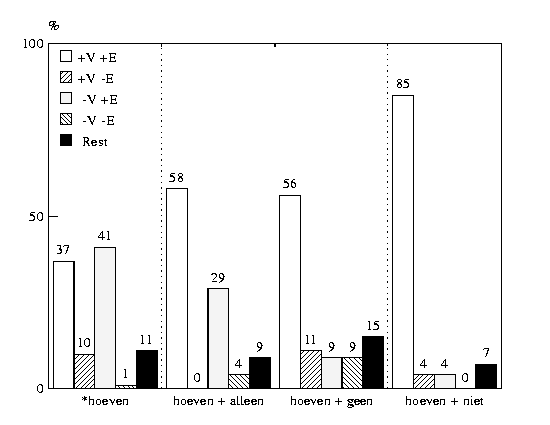
Up to Chapter 3 Table
of
ContentsA first notable attribute of this graph is the dominance of the +V+E bars in the grammatical test sentences (i.e. the hoeven+alleen, hoeven+geen, and hoeven+niet items). The +V+E bar is particularly high for the hoeven+niet sentences; in 85% of the cases, the subjects preserved both hoeven and its licensing environment niet (not) in their ERIC responses. The other grammatical test sentences, with geen (no, quant.) and alleen (only) as licensers, have a somewhat lower score in this category. Still, these sentences were reproduced with both hoeven and its licenser preserved in the majority of cases: 56% and 58%, respectively. The +V+E bar is lowest in the ungrammatical *hoeven items: only 37% of the time did the children leave hoeven and its non-licensing environment intact in their responses. Unlike the grammatical test sentences, +V+E is not the dominant score in the *hoeven items, but instead the -V+E score (41%), in which hoeven is exchanged for a different verb.
The +V+E scores, as a measure of acceptability, thus indicate that the children are most comfortable with the hoeven+niet sentences and least with the *hoeven sentences. The hoeven+alleen and hoeven+geen sentences occupy an in-between position. This is also clear from the mean +V+E scores, given in Table 3.5.
| Mean | St. Dev. | Variance | |
|---|---|---|---|
| *hoeven | 1.13 | 0.83 | 0.6952 |
| hoeven+alleen | 1.73 | 1.16 | 1.3524 |
| hoeven+geen | 1.67 | 1.35 | 1.8095 |
| hoeven+niet | 2.53 | 0.83 | 0.6952 |
The two other columns in this table - with the standard deviations and the variance - show that hoeven+geen and hoeven+alleen in addition are the two test sentence types which elicited less stable response patterns; their standard deviations and variance are relatively high, compared to the hoeven+niet and *hoeven sentences.
Up to Chapter 3 Table
of ContentsWhen the subjects do not preserve hoeven and its environment in their ERIC responses, three scoring categories are distinguished: +V-E, -V+E, and -V-E. As becomes clear from the graph, the last mentioned category occurred only rarely. This is also the least informative response, since changes to both the verb and its environment turn the original test sentence into a completely different one, which no longer has a direct link with hoeven and its possible licensers (see the examples in Table 3.4).
Up to Chapter 3 Table
of ContentsOf much more interest is the -V+E category, in which hoeven is exchanged for a different verb. As becomes clear from the graph, the children had a strong tendency to give this type of response in the *hoeven items: 41% of the time, they exchanged hoeven for a non-polarity verb - for instance moeten (must/have to), willen (to want), mogen (may), or krijgen (to get) - turning these ungrammatical sentences into grammatical ones. [9] In the grammatical test sentences with a licenser, where exchanging the verb does not have a decisive influence on grammaticality, this tendency was much lower: 29% in the hoeven+alleen items, and only 9% and 4% in the hoeven+geen and hoeven+niet items, respectively.
Up to Chapter 3 Table
of
ContentsFinally, there is the category +V-E, in which hoeven is preserved, and its environment has been changed. In general, the frequency of this type of response is low, especially in the hoeven+alleen and hoeven+niet items. The 11% of +V-E responses in the hoeven+geen sentences is solely made up by substitutions of niet (not) for geen (no, quant.), thus replacing one licenser by another. This did not affect the grammaticality of the test sentences. When such substitutions occurred, it was always in rather loose reproductions of the original test sentences. For instance:
The 10% +V-E responses in the *hoeven category is made up by licenser insertions, which turned these ungrammatical sentences into grammatical ones. The added licensers were niet (not) or geen (no, quant.) (cf. the a)-response), or alleen (only) (cf. the b)-response):
There is also an example of a child who added even two licensers to a *hoeven sentence:
Together with the 41% -V+E responses, the 10% +V-E responses make a total of 51% correcting changes to the *hoeven items.
Up to Chapter 3 Table of ContentsThe Acting Out response in each test item occurred after the ERIC response, as an assessment of meaning assignment: the child shows what the sentence means to him by either carrying out an action on props (in thirteen out of the fifteen test items) or by pointing out a picture (in two test items). These responses were scored with respect to an affirmative or negative meaning assignment - that is, whether the object mentioned in the test sentence was taken or pointed out (corresponding to an affirmative meaning) or not (corresponding to a negative meaning). The proportional distribution of these two possible responses per test sentence type is given in Figure 3.4 below.
Figure 3.4: AO responses per test sentence type
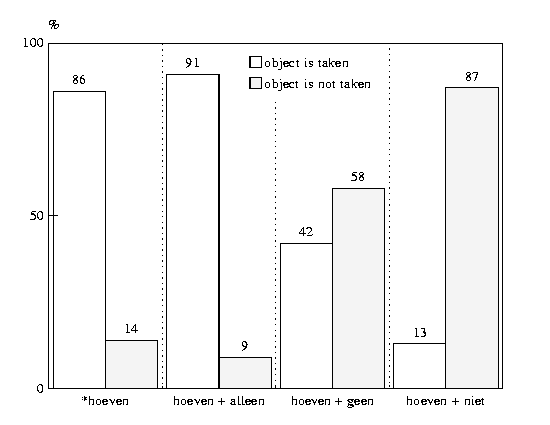
Notable at first sight in this graph is the deviant pattern represented by the hoeven+geen category, in which the two response types cluster around the middle: 58% of these sentences was assigned a negative meaning, while 42% was acted out as affirmative. In the other three categories, the results have a much stronger tendency to cluster in one particular pole: affirmative meaning assignments were vastly superior in the *hoeven and the hoeven+alleen items (86% and 91%, respectively), as were negative meaning assignments in the hoeven+niet items (87%).
Up to Chapter 3 Table of
ContentsFirst, we will concentrate on the responses in the *hoeven category, which are of crucial importance for one of the hypotheses, to wit that hoeven might be a verb with an implicit negative meaning (cf. Hypothesis II). If this hypothesis were true, then the appearance of hoeven in unlicensed environments would be correct for children, and such sentences should have a negative meaning for them (note that, in order to investigate this hypothesis, there was no bias manipulation in these items). The ERIC responses have already given a clear indication that the three year old subjects are not comfortable with *hoeven sentences, since they made a total of 51% amendments to these sentences. Their Acting Out responses provide additional evidence that the implicit negative meaning hypothesis cannot be true: an overwhelming majority (86%) of these sentences was acted out as having an affirmative meaning. The evidence becomes even stronger when we take into account that the remaining 14% negative Acting Out responses for a substantial part are paired with the +V-E responses on the ERIC task, in which the children inserted a negative licenser in these test sentences. See the example below:
First, in the ERIC response, a licenser is added to the ungrammatical sentence. And subsequently, the resulting negative sentence is acted out accordingly, as having a negative meaning.
Up to Chapter 3 Table of
ContentsThe grammatical test items - the hoeven+alleen, hoeven+geen, and hoeven+niet sentences - were preceded by counterbiased stories. As was pointed out earlier (cf. Story bias manipulation), this bias might affect the ERIC and/or Acting Out responses in different ways. The discussion of the ERIC results has already shown that, in general, the meaning of these test sentences remained intact; the children definitely did not choose to leave out the licenser (cf. the discussion of the results in the +V-E category). The question now remains as to whether the children resorted to what might be called the conflict option - that is, saying one thing but acting out another, to wit the interpretation which is in accordance with the story bias but not with the test sentence. A look at Figure 3.4 seems to suggest that such a conflict indeed arose in the hoeven+geen items. In this category, there is a relatively high percentage (42%) of affirmative Acting Out responses, which are in bold conflict with the preceding ERIC responses. An example of such an ERIC - Acting Out conflict is the following:
Seeing these conflicting responses as a result of story bias manipulation, however, immediately poses another question: why did such conflicts occur so often in the hoeven+geen items, and relatively rarely in the hoeven+alleen and hoeven+niet items, which also contained a story bias?
To be sure, the bias did have some effect in the latter items, as became clear from occasional comments during Acting Out. For instance:
The child first identified the yellow marker as being a logical choice, but reluctantly chose to obey the meaning of the ERIC response by taking another marker.
There were also some examples of children deliberately acting out the biased interpretation and rejecting the interpretation which would be in accordance with the ERIC response. For instance:
Such conflicts between ERIC and Acting Out responses, however, occurred only rarely, compared to the hoeven+geen items. Moreover, in the hoeven+geen items, the children never made comments on the bias; their conflicting Acting Out responses appeared to happen as a matter of course. As yet, it is still not clear what the catch behind this deviant Acting Out pattern in the hoeven+geen items might be. [10]
Nevertheless, the story bias did provide valuable information by showing what the subjects did not do: they did not resort to just leaving the licenser out in their reproductions of the counterbiased test sentences. Such a minimal change could in principle have solved the clash between context and test sentence, but would in practice have led to an ungrammatical sentence. It is important to note that the absence of such corrections for the worse cannot be a mere artefact of the ERIC task (i.e. telling what Bert had said) since the subjects often did take the trouble to make amendments in their ERIC responses on the *hoeven items. This result becomes all the more significant when it is taken into account that the *hoeven sentences were preceded by neutral stories and thus did not provide a pragmatic reason for such changes to be made, only a grammatical one: to wit that the NPI hoeven needs a licensing environment.
Up to Chapter 3 Table of
ContentsAfter this discussion of the proportional distribution of responses, the different hypotheses about young children's sensitivity to the restrictions on NPIs, presented earlier, will now be reviewed in the light of a statistical analysis of these experimental data.
A one-way analysis of variance (ONEWAY; SPSS/PC+ 5.0.1) [11] shows significant differences between the +V+E scores on the four test sentence types, F(3, 56) = 4.3933, p = .0076. Post hoc testing with the Tukey procedure shows a significant difference between the *hoeven and the hoeven+niet test sentences at the .05 level. Furthermore, two homogeneous subsets were identified, whose members' highest and lowest means do not differ by more than the shortest significant range for a subset of that size. Subset I consists of the *hoeven, hoeven+geen, and the hoeven+alleen items. Subset II consists of the hoeven+geen, hoeven+alleen, and the hoeven+niet items.
The four hypotheses, presented earlier, are repeated here for the sake of convenience:
First of all, the ONEWAY shows that Hypothesis III - that hoeven is a regular expression without specific restrictions on its distribution - cannot be true. If hoeven for these children were just a regular modal verb that can be used either affirmatively or negatively, then the four test sentence types should have been equally acceptable, and the ONEWAY shows that this is not the case.
If the three-year-olds do not regard hoeven as just another modal verb with no particular restrictions, then the subsequent question is: what do the children consider to be a correct environment for this verb? Two possibilities were formulated in Hypothesis I and II, respectively: hoeven might be restricted to the company of niet (not) only, or it might be an implicit negative verb in affirmative sentences. As for the latter, the experimental Acting Out data discussed in section 3.13.2 have conclusively shown that this hypothesis is not viable.
The question now remains as to whether there is evidence in support of Hypothesis I, to wit that hoeven can only occur in combination with niet (not). If the children's knowledge about the distribution of hoeven did not go beyond this combination, then the expectation is that only hoeven+niet sentences would be considered as correct. Indeed, the percentage of +V+E responses on the hoeven+niet items is extraordinarily high (85%) compared to the other test sentence types. Obviously, the subjects are most comfortable with the hoeven+niet sentences. This is not an unexpected result, as it is in complete accordance with the spontaneous speech data, which also shows an overwhelming majority of utterances in which hoeven is accompanied by niet. Nevertheless, the children's high performance on the hoeven+niet items is not exclusive enough to provide unconditioned support for Hypothesis I. If hoeven in combination with niet (not) were considered to be the only correct form, then a significant difference could have been expected between the hoeven+niet sentences and all the other test sentence types. The post hoc Tukey procedure shows, however, that there is no such immediate and sharp contrast between hoeven+niet and the rest; the significant difference is between the responses on the grammatical hoeven+niet and the ungrammatical *hoeven sentences. Furthermore, the identification of two homogenous subsets shows that there is an in-between zone of hoeven+alleen and hoeven+geen sentences and sheds further light on how the children experience the four different test sentence types. The first subset to be identified includes the *hoeven, hoeven+geen, and hoeven+alleen sentences. This subset can be viewed as the less successful items, in comparison to the hoeven+niet items. But there is also an identifiable second subset, hoeven+geen, hoeven+alleen, and hoeven+niet, which can be interpreted as evidence that children's knowledge of acceptable licensing environments does indeed go beyond the licenser niet (not).
To sum up, the experimental data do not provide full support for Hypothesis I, that niet (not) is specified as the only proper environment for hoeven. Neither is there any support for Hypothesis II and III, that hoeven is just a regular modal verb, or a verb with an implicit negative meaning. The experimental evidence against these three hypotheses is taken as support for the fourth one: three year old children appear to already know that hoeven is a special verb, with a distribution restricted to certain licensing environments. In straightforwardly affirmative sentences, hoeven is considered as ungrammatical: the +V+E responses in this category are lower than in the licensed test sentences. Only 37% of the time do the children preserve verb and environment in the *hoeven sentences; more often, they make amendments in their ERIC responses by exchanging hoeven for another verb without polarity restrictions, or by adding a correct licenser. In combination with a licenser, hoeven is considered as grammatical: the children tend to preserve both the verb and the licenser in such sentences, even though the story bias manipulation in these items provided a pragmatic reason to change these sentences.
Up to Chapter 3 Table of
ContentsIn this chapter, apparently incompatible patterns in children's early NPI use, as they appeared from an investigation of spontaneous speech, were the motive for an experimental study. The patterns at stake were, on the one hand, continuity of the very restricted distribution which was found from the onset - that is, NPIs occurring in the company of the negation niet (not); and on the other hand, the emergence of ungrammatical utterances, in which NPIs are not accompanied by a legal licenser. These errors could be divided into two types, with respect to whether they occur in utterances with a negative or an affirmative meaning.
What the children's ungrammatical utterances clearly showed is that the task of NPI acquisition is not approached with a strictly conservative strategy, since the adult model does not provide examples of unlicensed NPIs. At the same time, there were indications that the children's errors were unlikely to be the result of mere overgeneralization. This state of affairs gave rise to the surmise that the errors in the children's speech are not what they look like at first sight, but might represent an underlying attempt to adhere to licensing. Children might be aware of the fact that NPIs are subject to licensing restrictions, but their understanding of what exactly constitutes correct licensing environments might itself still be in development.
In an experimental study, the viability of this alternative analysis, that children are sensitive to the licensing restrictions on NPIs, was then compared to that of three other possibilities - each one based on a particular pattern occurring in spontaneous speech. The experimental results did not provide support for any of the analyses of a spontaneous speech pattern in isolation, but instead pointed in the direction of the alternative explanation. The experimental data justify the conclusion that three year old children are already sensitive to the restrictions on NPIs. They know that an NPI is not allowed in straightforwardly affirmative sentences, but needs a licensing environment.
This conclusion gives clear directions for the continuation of the investigation from here. As is obvious from the patterns found in spontaneous speech, there is still a lot that the children do not know about the licensing of NPIs. If the findings from spontaneous speech indeed represent licensing rules in development, then a closer look must be taken at these data, to see what they can reveal about the underlying pattern in the process of acquiring the variety of licensing environments for NPIs.
 On to next chapter: `The Spontaneous Speech Data Revisited'Up to general Table of Contents
 Back to previous chapter: `The Onset'