 Up to general Table of Contents
Negative Polarity Items and Negation —
Chapter
1
- 1.1 — Outline
- 1.2 — The restricted distribution of
a class of verbal
idioms
- 1.3 — Pragmatic entailment
- 1.4 — Scale-reversing
environments
- 1.5 — Negative polarity items: a
multi-facet
phenomenon
- 1.5.1 — NPIs of unknown origin
- 1.5.2 — Domains of meaning
- 1.5.3 — Idiosyncratic behavior
- 1.5.4 — Crosslinguistic differences
and historical
developments
- 1.6 — Theories of polarity
sensitivity
- 1.6.1 — Ladusaw: semantic
entailment
- 1.6.2 — Dowty: facilitation of
inferences
- 1.6.3 — Zwarts: the relative
strength of licensers
- 1.6.4 — Linebarger: negative
implicatures
- 1.6.5 — Negative polarity items:
one
phenomenon?
- 1.7 — Issues in the psycholinguistic
study of NPIs
- 1.7.1 — Users' intuition about
polarity
sensitivity
- 1.7.2 — The acquisition of
NPIs
- 1.7.3 — The `no negative evidence
problem'
- 1.7.4 — Outlook: acquiring the
correct licensers for
NPIs
1.1 — Outline
This chapter is
divided in three
main parts and sketches the background of the developmental study
of negative polarity items. First,
a characterization of the behavior of negative polarity items is
given, based on data from different
languages, in sections 1.2,
1.3,
1.4, and 1.5. These
observations are
followed in section 1.6 by a short account of
various theoretical
approaches to polarity sensitivity. The last part of the chapter,
starting with section
1.7, is concerned with the issues which are
relevant in the
psycholinguistic study of negative polarity items, introducing
the research questions which will be
explored in later chapters.
Up to Chapter 1 Table of Contents
1.2 — The restricted distribution of
a class of verbal
idioms
In several languages, there is a collection of similar
verbal idioms. Although the
lexical content of these expressions differs, it is nevertheless
clear that they are variations on the
same theme. This becomes evident from their uniform structure -
NP + verbal predicate - and
similar distributive pattern. Examples from a few languages are
given below:
- English:
- to lift a finger, to drink a drop, to budge
an inch, to hurt a
fly
- Dutch:
- een spaan heel laten (to leave a chip of wood
intact), een strobreed in
de weg leggen (to lay a straw-width in the way), een knip voor
de neus waard zijn (to be worth a
snap in front of the nose), een vinger uitsteken (to reach out
a finger)
- German:
- einen Muckser von sich geben (to give a sound
from
oneself) (Zwarts 1995),
ein Sterbenswörtchen sagen (to say a dying-word)
(Kürschner 1983),
einen Finger krummachen
(to bend a finger), einen Pfifferling wert sein (to be worth a
toadstool)
- Norwegian:
- å eie nåla i veggen (to own the
needle in the wall),
å røre en finger (to move a finger), å
være verdt en øre (to be worth
an øre), å se hånda foran seg (to see the hand
in front of oneself)
- French:
- manger une bouchée (to eat a mouthful),
boire une goutte (to
drink a drop), verser un kopeck (to pay a copeck)
(Hoppenbouwers 1983)
- Spanish:
- ver un alma en la calle (to see a soul on the
street), pegar un ojo (to
close an eye), decir ni pio (to say a peep) (Víctor
Sánchez-Valencia, p.c.)
- Greek:
- leo leksi (say word), pino ghulja (drink drop),
dino dhekara (give 10-cent-coin), klino mati (close eye)
(Anastasia Giannakidou, p.c.)
- Hungarian:
- a kisujját mozdítani (to move
his/her little finger),
egy cseppet érdekelni (to care a bit), egy falatot enni
(to eat a mouthful), a füle
botját mozdítani (to move the `stick of the
ear') (Ildikó
Vaskó, p.c.)
Provisionally, the distribution of these expressions can be
characterized as restricted, since they
only appear in a subset of the configurations in which they, by
virtue of their syntactic properties as
noun/verb combinations, would be grammatical. This is illustrated
in the following examples, with
some of these idioms from English and Dutch:
| (1) |
| English to lift a
finger; Dutch een vinger
uitsteken |
| a)
| None of the bystanders lifted a finger to help
Melissa.
Geen van de
omstanders stak een vinger uit om Melissa te
helpen. |
| b)
|
One of the bystanders lifted a finger to help Melissa.
Een
van de omstanders stak een
vinger uit om Melissa te helpen. |
| (2) |
| English
to drink a drop; Dutch een druppel
drinken |
| a)
| Frank didn't drink a drop of wine at the party.
Frank
heeft op het feest geen
druppel wijn
gedronken. |
| b)
| Frank drank a drop of wine at the party.
Frank heeft
op het feest een druppel
wijn gedronken. |
| (3) |
| English
to utter a sound; Dutch een kik
geven |
| a)
| Nobody in the auditorium uttered a sound.
Niemand in
de zaal gaf een
kik. |
| b)
|
Somebody in the auditorium uttered a sound.
Iemand in de
zaal gaf een
kik. |
| (4) |
| English
to hurt a fly; Dutch een vlieg kwaad
doen |
| a)
| John never hurts a fly.
Jan doet nooit een vlieg
kwaad. |
| b)
|
John sometimes hurts a fly.
Jan doet soms een vlieg
kwaad. |
The a)-examples are perfectly normal utterances, but the
b)-examples certainly are not. Yet,
both the a)- and b)-sentences are syntactically correct strings
of words. It thus appears that the
distribution of noun/verb combinations such as to lift a
finger (een vinger
uitsteken), to drink a drop (een druppel drinken), to
utter a sound (een kik
geven), and to hurt a fly (een vlieg kwaad doen)
cannot be completely
predicted from their syntactic properties alone, but must be
subject to additional restrictions.
The anomaly of the b)-examples obviously is related to their
meaning; it is difficult to
understand these sentences under their idiomatic reading.
Benson et al. (1986)
characterize idioms
as relatively frozen expressions whose meanings do not reflect
the meanings of their component
parts. In the a)-examples above, this idiomatic meaning is
effective and produces the intended result.
Thus, the a)-sentence in
(1), instead of telling something about the
bystanders' fingers, conveys
the meaning that Melissa was helpless. In the same way, the
meanings of the other a)-sentences are,
respectively, that Frank remained sober at the party, that it was
completely silent in the auditorium,
and that John is a harmless person. In the b)-sentences, however,
the literal meaning of these
expressions is forced into focus, resulting in an anomaly of
semantic and pragmatic nature. Thus, we
may wonder how a minimal offer of goodwill such as lifting a
finger could help Melissa, how Frank
managed to drink exactly one drop of wine at the party, et
cetera. The literal meaning of these
sentences does not make much sense, and it is indeed very
unlikely that such utterances will ever
occur in natural conversation.
What is it that induces this difference in meaning and
acceptability between the a)- and the b)-examples? The crucial
factor appears to be the presence or
absence of negation. Idioms such as
to lift a finger (een vinger uitsteken), to drink
a drop (een druppel
drinken), to utter a sound (een kik geven), and to hurt
a fly (een vlieg kwaad
doen) obviously thrive in the company of a negative
expression, such as none
(geen), not (niet), nobody (niemand), or never
(nooit). It is not, however,
the case that a specific negative form is an inseparable part of
the idiom itself. Rather, these idioms
seem to require the presence of some negative
expression. Thus, the expression
to drink a drop (een druppel drinken) does not form a
fixed idiom with the negation
not (niet), but can appear in a variety of negative
sentences. See for instance the
following examples:
(5)
| I have never
seen Frank drinking a drop of alcohol.
I heb Frank nog
nooit
een druppel alcohol zien drinken. |
(6)
|
Nobody drank a drop of alcohol at Frank's
party.
Niemand dronk een druppel alcohol op
Franks
feest. |
(7)
|
None of the guests drank a drop of
alcohol.
Geen van de gasten dronk een druppel
alcohol. |
To summarize the observations so far, languages contain a
class of verbal idioms which not
only resemble each other in form, but which also display a
similar distributive pattern in sentences.
The restricted distribution of these expressions obviously is not
a matter of fixed collocation, but
leaves room for some variation. The questions which arise on the
basis of these observations are:
what are the boundaries of this restricted distribution, and why
do these restrictions apply to these
particular expressions?
Up to Chapter 1 Table of Contents
1.3 — Pragmatic
entailment
Fauconnier's work on
implicational scales (Fauconnier
1975;
1979;
1980) explains the logic
underlying the distribution of these
expressions, answering both the above questions at the same time.
Fauconnier shows that there is a
natural reason why these expressions occur in these particular
environments: in combination with
each other they result in pragmatically strong statements.
Fauconnier's argumentation starts with the observation that
superlatives may produce
quantificational effects in certain sentences. For example:
| (8) | Frank can solve the most
difficult
problem. |
In this sentence, the superlative the most difficult
problem has the force of a
universal quantifier: if Frank can solve even the most difficult
problem, then we may infer that Frank
can solve any problem. Fauconnier suggests that the
quantificational value of the
proposition in (8) is linked to a pragmatic
scale of complexity:
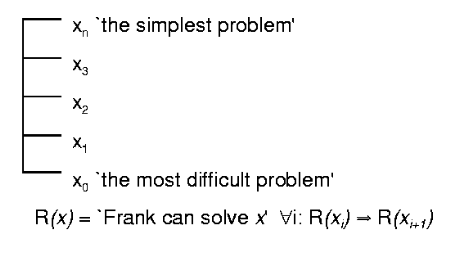
This scale represents the decreasing complexity of problems,
such that problem x3
is less complex than problem x2, problem x2 in
turn is less
complex than problem x1, and so on. The lowest point on
the scale is denoted by
the superlative: it is the most difficult problem. Now, when it
is true that Frank can solve
x1, we assume that Frank will also be able to solve
problems x2 and
x3, which are higher on the scale and therefore are less
complex. In particular, if
Frank can solve the most difficult problem, the lowest point on
the scale, this implicates that Frank
will be able to solve any problem, since all other
problems are higher on the scale
and therefore are less complex. Fauconnier notes that this is a
pragmatic implicature rather than a
strictly logical implication, since one could think of
circumstances in which Frank, although he is
presented with a simpler problem than the lowest point on this
scale, will not be able to solve it.
However, on the basis of common sense, it is appropriate to
assume that the less complex a problem
is, the more likely it is that a person will be able to solve
it.
Note that this quantified reading is no longer effective when
the sentence is negative:
| (9) | Frank can't solve the most
difficult
problem. |
On the pragmatic scale of complexity, it is not possible to
make inferences from
(9) to positions higher on the scale, as was
possible with the positive
counterpart, (8). Thus, the superlative
the most difficult
problem is quantificational in the affirmative sentence
(8) but
not in the negative sentence (9). This
difference is caused by the
entailment-reversing effect of negation. On the same scale of
complexity, the entailment pattern of
the negative sentence (9) is downward instead
of upward:
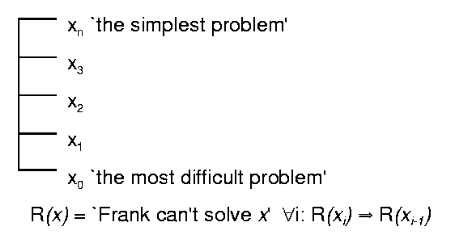
When it is true that Frank cannot solve x2, we assume
that Frank will not be
able to solve x1 either, which is lower on the scale and
therefore presents a more
complex problem. Now it is the opposite end of the scale which
has the meaning of a universal
quantifier:
| (10) | Frank can't solve the
simplest
problem. |
If Frank cannot solve the simplest problem, the highest point
on the scale, this pragmatically
implicates that Frank will not be able to solve any
problem, since the other
problems are all lower on the scale, and therefore are more
complex.
The evidence for scale reversal with negation thus has the
following form: a
superlative gives rise to a quantified reading in a sentence but
not in its negation, and the polar
opposite of that superlative gives rise to the quantified reading
only in the negative counterpart of the
sentence (Fauconnier
1979: 291).
Thus, scalar end points which of themselves do not have any
universal entailments may obtain
quantificational force in the entailment-reversing environment
of negation. It is exactly this
combination of a scalar end point and an entailment-reversing
environment which gives noun/verb
combinations such as to lift a finger (een vinger
uitsteken) and to drink a
drop (een druppel drinken) the pragmatic force of a
universal quantifier. The nouns in these
expressions stand for the idiomatic low points of implicational
scales. Thus, lifting a finger can be
regarded as the low extremity on a scale of physical activities.
Likewise, a drop indicates the
minimum on a quantity scale of liquids, as is illustrated in the
figure below:[1]
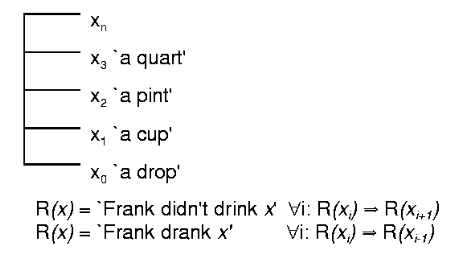
This scale is implicational with respect to the sentence
Frank didn't drink a
drop:
(11)
| Frank didn't
drink
a drop => Frank didn't drink a cup => Frank
didn't drink a pint => Frank didn't drink a
quart |
In this sentence, a drop is equivalent to a universal
quantifier: saying that
Frank did not drink the least amount of liquid is equivalent to
saying that he drank nothing at all.
The combination of a scalar end point with negation thus appears
to be one which is only natural in
the view of successful communication, since it results in a
strong statement in terms of maximization
of the conventional implicatures which can be made.
Up
to Chapter 1 Table of Contents
1.4 — Scale-reversing
environments
As was shown in the previous section, the idioms of minimum
quantity introduced in section
1.2 obtain universal force by appearing in the
entailment-reversing
environment of negation. This was illustrated with the sentence
negation not, which
also is used in the formalization of reversed entailment in the
contraposition law in propositional
logic: if P => Q, ¬Q => ¬P
There are, however, more environments in natural language
which have the ability to reverse
entailment, such as the negative expressions none, nobody,
never, nowhere, no,
and nothing. As can be seen in examples
(1) -
(4), such environments also give rise to
quantified readings of idioms of
minimum quantity. Fauconnier
(1979) has pointed out
that it is not only sentence negation and negative quantifiers
that are entailment-reversing. There is a
wide variety of linguistic environments which also has this
property, for example conditionals,
universal statements, comparatives, before-clauses, and
too...to.
Indeed, as the following examples show, verbal idioms like
to drink a drop (een
druppel drinken), to lift a finger (een vinger uitsteken),
and to utter a sound (een
kik geven) can appear in this whole variety of
environments:[2]
| (12) | conditional: |
| If you drink (even) a drop of wine, I
won't drive
along with you.
Als je (ook maar) een druppel wijn drinkt, rijd ik niet met je
mee. |
| (13) | universal statement: |
| Anybody who drinks (even) a drop of
alcohol will
be immediately removed from the auditorium.
Iedereen die (ook maar) een druppel alcohol drinkt, zal
onmiddellijk uit de zaal verwijderd
worden. |
| (14) | comparative: |
| Frank would (even) walk a ten-mile
detour rather
than lift a finger to help someone cross the street.
Frank loopt nog liever tien kilometer om dan dat hij (ook maar)
een vinger uitsteekt om iemand te
helpen oversteken. |
| (15) | before: |
| Frank was robbed of his money before he
could
(even) utter a sound.
Frank werd van zijn geld beroofd voordat hij (ook maar) een kik
kon geven. |
| (16) | too...to: |
| Frank was too shy to (even) utter a
sound during the
meeting.
Frank was te verlegen om tijdens de vergadering (ook maar) een
kik te geven.
|
The restricted distribution of idioms of minimum quantity thus
appears to be semantically and
pragmatically functional: by appearing in environments which have
the ability to reverse entailment,
these expressions induce strong statements.
Up
to Chapter 1 Table of Contents
1.5 — Negative polarity items: a
multi-facet
phenomenon
The foregoing constituted a clear example of how languages are
shaped by their users to meet
certain communicative demands. The behavior of verbal idioms like
to drink a drop
and to lift a finger is not merely an arbitrary fact of
grammar, unaffected by
considerations of meaning or pragmatics. Rather, the restricted
distribution of these expressions can
be understood in functional terms, as meeting the requirements
of successful communication. Interestingly, it appeared that the
restrictions on these idioms have
a universal basis: they are founded in a
language-independent entailment pattern. Therefore, it is not
surprising that this class of idioms is a
recurrent phenomenon in different languages.
The scale principle thus offers a satisfactory account for the
restricted distribution of a
crosslinguistic class of idioms. The picture, however, is not
that clear anymore when these idiomatic
expressions are seen as being part of a much more extensive
phenomenon. It is a well-known
observation that languages contain quite varied collections of
words and expressions with a behavior
comparable to that of the verbal idioms discussed in the
foregoing (cf.
Van der Wouden 1994a for an
inventory of observations
from a variety of languages). The distribution of these items is
restricted to the same environments,
with negation being the most dominant one; hence the name
Negative Polarity
Items (NPIs, for short). Intuitively, it is felt that these
items constitute one coherent
phenomenon and that there must be a unified account for the
patterns characterizing their
distribution. The account in terms of scalar implicatures,
however, which fits so well for the
distribution of the class of negative polarity idioms, turns out
to be not simply applicable to all NPIs.
As will be set out in the following paragraphs, the phenomenon
of polarity sensitivity is many-sided:
NPIs cluster in widely different domains of meanings, are subject
to historic changes, and show - to
some extent - idiosyncratic behavior, both within and across
languages.
Up to Chapter 1 Table of
Contents
1.5.1 — NPIs of unknown origin
Investigation of large corpora of written speech - carried out
within the research project
Reflections of Logical Patterns in Language Structure and
Language Use at the
University of Groningen - has yielded an inventory of several
hundreds of NPIs in Dutch. A
substantial number of these expressions is listed and categorized
in
Table 1.2. This inventory will be
discussed later on; for the time
being, a closer look is taken at only four of the expressions
that appear on this list: hoeven
(have to/need), meer (anymore), kunnen schelen
(to
care), and kunnen uitstaan/velen (can stand). As
the following examples
show, these expressions are NPIs, since they are not allowed in
straightforwardly affirmative sentences (cf. the a)-examples),
but always need a certain licensing
environment to appear correctly (cf. the
b)-examples):
| (17) |
| hoeven (have
to/need) |
| a)
| *Frank hoeft zijn leerlingen altijd iets uit te
leggen.
Frank has his pupils always something to explain.
`Frank always has to explain something to his pupils.' |
| b)
|
Frank hoeft zijn leerlingen nooit iets uit te leggen.
Frank has his pupils never something to explain.
`Frank never has to explain anything to his pupils.' |
| (18) |
| meer
(anymore): |
| a)
| *Frank is hier meer.
Frank is here anymore.
`Frank is still here.' |
| b)
|
Frank is hier niet meer.
Frank is here not anymore.
`Frank isn't here anymore.' |
| (19) |
| kunnen schelen (to
care): |
| a)
| *Het kan Frank iets schelen dat zijn leerlingen
te laat komen.
It can Frank something differ that his pupils too late come.
`It bothers Frank if his pupils arrive late for class.' |
| b)
|
Het kan Frank niets schelen dat zijn leerlingen te laat
komen.
It can Frank nothing differ that his pupils too late come.
`Frank doesn't care if his pupils arrive late for
class.' |
| (20) |
| kunnen uitstaan/velen
(can stand): |
| a)
| *Iedereen kan Frank uitstaan/velen.
Everybody can Frank stand.
`Everybody can get along with Frank.' |
| b)
|
Niemand kan Frank uitstaan/velen.
Nobody can Frank stand.
`Nobody can stand Frank.' |
The distribution of these four NPIs in actual language use is
shown in Table1.1:
[3]
Table 1.1 —
Environments for four Dutch NPIs
Negation = niet (not); Negative expression = geen (no),
niets/niks (nothing), niemand (no one), nooit (never), nergens
(nowhere), noch (nor), geenszins (not at all), allerminst (not
in the least); Inherently negative = alleen (only), maar
(only/just), slechts (only/just), pas (until), weinig
(few/little), nauwelijks (hardly), zonder (without), zelden
(rarely), minder (less), het minst (the least), moeilijk
(difficult).
| hoeven
N=339 | meer
N=832 | kunnen schelen
N=298 | kunnen
uitstaan/velen
N=132 |
|---|
| Negation | 61% | 62% | 37% | 76% |
|---|
| Negative expression | 18% | 35% | 34% | 11%
|
|---|
| Inherently negative | 21% | 3% | 10% | 5%
|
|---|
| Question |
0% | 0% | 17% | 1%
|
|---|
| Affirmative | 0% | 0% | 2% |
7% |
|---|
From this table it becomes clear that hoeven, meer, kunnen
schelen, and
kunnen uitstaan/velen appear with a limited set of
licensers, which by and large
correspond to the environments in which the idioms of minimum
quantity can occur. However,
where the restricted distribution of these idioms was shown to
follow naturally from their status as
end points on implicational scales, there appears to be no such
natural connection between meaning,
pragmatics and distributive properties for these four NPIs. It
is not clear how these expressions could
be regarded as scalar end points, and neither does there appear
to be any semantic or pragmatic
reason why their distribution should be limited to only these,
for the most part negative, environments. To see this, compare
the b)-examples in
(17) - (20) with the
Dutch b)-examples given in
(1) - (4). The common
characteristic of
these sentences is the fact that they are aberrant, without being
syntactically incorrect. There is,
however, a difference between the two sets of examples with
respect to the underlying reason for
their anomaly. The anomaly of the first set of examples, the
b)-sentences in
(1) - (4), is of semantic
and pragmatic nature:
affirmative sentences with idioms of minimum quantity are not
implicational with respect to scales
and therefore result in weak statements. Such a motivation,
however, is not available for the anomaly
of the b)-sentences in
(17) - (20),
containing other NPIs. There is no semantic or pragmatic reason
why hoeven, meer, kunnen
schelen, and kunnen uitstaan/velen should be
correct in the negative a)-sentences, but not allowed in
affirmative sentences, as in the
b)-examples. Depending on the
situation, it makes perfect sense to talk about something being
necessary, as well as about something
being not necessary (as in (17) a) and b)).
In the same way, one might
want to talk about an ongoing situation as well as a situation
which is no longer the case (as in
(18) a) and b)), about personal involvement
as well as indifference (as in
(19) a) and b)), and about personal
preference as well as dislike (as in
(20) a) and b)). As a consequence, one would
expect a language to
offer the means to express the meanings of both the a)- and
b)-sentences. In fact, Dutch provides its
speakers with the opportunity to express both meanings, but under
the specific grammaticality
condition that different expressions are used in the a)- and
b)-sentences. In the a)-sentences, the NPIs
are correct, but in order to express the positive counterparts
of these sentences, other, non-polarity
sensitive expressions are needed: moeten (have
to/must), nog
(still), erg vinden (to bother), and kunnen
opschieten (to get
along).[4] The correct
counterparts of the b)-sentences in
(17) - (20), containing
these non-polarity
sensitive expressions, are given in (21) - (24):
| (21) | moeten (have
to/must): |
| Frank moet zijn leerlingen altijd
iets
uitleggen.
Frank has his pupils always something to explain.
`Frank always has to explain something to his pupils.' |
| (22) | nog (still): |
| Frank is hier nog.
Frank is here still.
`Frank is still here.' |
| (23) | erg vinden (to
bother): |
| Frank vindt het erg als zijn
leerlingen te laat
komen.
Frank finds it annoying if his pupils too late come.
`It bothers Frank if his pupils arrive late for class.' |
| (24) | kunnen opschieten (to get
along): |
| Iedereen kan met Frank
opschieten.
Everybody can with Frank get along.
`Everybody can get along with Frank.' |
Thus, there appears to be no obvious semantic or pragmatic
necessity for the grammaticalization of hoeven, meer, kunnen
schelen, and
kunnen
uitstaan/velen as NPIs. The unacceptability of the
b)-examples in
(17) - (20) remains
unmotivated; such
sentences are just `not done' in the grammar of Dutch. The
underlying reasons for the restricted
distribution of these expressions is as yet unclear.
Up
to Chapter 1 Table of Contents
1.5.2 — Domains of meaning
Although the distribution of NPIs does not follow in an
obvious way from semantic, syntactic,
or pragmatic properties - at least not for some of them, as was
shown in the previous paragraph - it
is intuitively clear that the phenomenon of polarity sensitivity
is not merely an arbitrary fact of
grammar, a linguistic limitation apropos of nothing. It is
claimed that grammaticalization processes in
a language are motivated by communicative needs and
speaker-hearer interactions
(Hopper and Traugott 1993), and
the same background
must be assumed for the grammaticalization of certain expressions
as NPIs.
Hoeksema (1994a) has
suggested that meaning
might be the crucial factor in the grammaticalization of NPIs.
He notes, as does
Van der Wouden (1994a), that
NPIs are not arbitrarily
distributed over the lexicon and that there are intuitions about
the meaning domains in the lexicon in
which NPIs most likely are to be found, as well as about the
domains which will not be a rich source
of NPIs. For example, in learning a foreign language, one would
not expect the words for
lamp or to travel to be restricted to only
negative sentences, questions, et cetera. It should be noted,
however, that this
knowledge is skewed: intuitions are rather
robust when it comes to excluding the possibility that
a word or expression with a
given meaning will be polarity sensitive, but they are weak when
it comes to actually
predicting that a given expression will be an NPI.
Although the meaning of an
expression may give a hint of possible polarity sensitivity - as
Hoeksema (1994a) put it,
certain expressions
are predestined to become polarity sensitive due to their
semantic properties - one can
never be sure whether such a possible NPI candidate actually will
develop polarity sensitive behavior.
The factors which lead to the grammaticalization of certain
expressions as NPIs are only potential,
and certainly not absolute: the phenomena that give rise
to language change are so complex
that they will perhaps never be understood in enough detail for
us to state precisely why a specific
change occurred in the past or to predict when one will occur and
if it does what it will be
(Hopper and Traugott 1993:
63).
The clustering of NPIs in specific domains of meaning is shown
in
Table 1.2. This inventory of Dutch
polarity sensitive expressions
is based on a large corpus of mainly written Dutch, compiled by
Jack Hoeksema. The table contains
a representative sample of the most frequently occurring NPIs in
Dutch, categorized according to the
basic meaning they have in common.
Up
to Chapter 1 Table of Contents
Table 1.2 — Dutch polarity
sensitive
expressions.
English translations are given in Appendix
A.
|
A. minimum quantity |
B. maximum quantity |
|---|
| verbal idioms | in jaren |
| een speld tussen kunnen krijgen | in
eeuwen |
| een strobreed in de weg leggen | voor
goud |
| een knip voor de neus waard zijn | ter
wereld |
| een hand voor de ogen zien | in de verste
verte |
| een haar krenken | in velden of wegen |
| NPs |
C. indifference |
|---|
| een moer | kunnen schelen |
| een klap | kunnen deren |
| een snars | kunnen donderen |
| een zier | kunnen verdommen |
| een greintje | zich ergens iets van
aantrekken |
| een sterveling | zich iets gelegen laten
liggen |
| een lor | ergens iets op uit doen |
| een bliksem | malen om |
|
D.
intolerance/dislike | iets
uitmaken |
|---|
| kunnen uitstaan | iets geven |
| kunnen velen | ertoe doen |
| kunnen hebben | om het lijf hebben |
| te harden zijn | om (de) hakken hebben |
| kunnen verdragen |
E. incapacity |
|---|
| kunnen verkroppen | iets kunnen helpen |
| kunnen zetten | iets kunnen laten |
| ergens tegen kunnen | baten |
|
F. matching | ergens iets aan
kunnen
doen |
|---|
| ergens voor onder doen | zoden aan de dijk
zetten |
| kunnen tippen aan | iets uithalen |
| kunnen evenaren |
G. unawareness |
|---|
| zijn weerga kennen | benul hebben |
|
H. degree | erg hebben in |
|---|
| bijster | notie hebben |
| noemenswaardig | idee hebben |
| hoegenaamd | weet hebben van |
|
I. special
cases | van...of...weten |
|---|
| hoeven |
|
| meer |
|
| ooit |
|
| ook maar |
|
Category A contains a selection of the idioms of minimum
quantity, which were presented in more
detail in section 1.2. The nouns in these
expressions all denote an
idiomatic minimum, such as the minimum width of een speld (a
needle) in
een speld tussen kunnen krijgen (to be able to get a needle
in between) and
een strobreed (a straw-width) in een strobreed in
de weg leggen (to lay a
straw-width in the way). In combination with their licensing
environments, these
expressions result in the pragmatic effect of not even A, let
alone B (where A is a
minimum, and B represents a point higher up the scale), as was
shown in section
1.3.
The same applies to the NPs, which constitute the second
subcategory under A. These NPs do
not appear in only one specific NP/verb combination but can occur
with a variety of verbs. For
instance, een moer (a nut) and een klap (a
slap) appear in
combination with - among others - doen/uitvoeren (to do),
snappen (to understand)
and waard zijn (to be worth).
The NPs listed under A in the table are only a fraction of the
NPs with NPI meaning which are
encountered in daily speech; the list can be extended ad
infinitum. Moreover, these expressions
appear to be a source of inventiveness and fluctuate with the
fashion of the moment; new creations
succeed each other at a rapid rate (see also
Note 1).
Up
to Chapter 1 Table of Contents
The expressions listed under B may seem to form a rather
incoherent group, since they have few
similarities in form. These expressions nevertheless share the
basic property that they can be linked
to pragmatic scales, just as the expressions under A. There is
one important difference between A
and B, though. Whereas the expressions under A denote a scalar
minimum, the expressions under B
denote the other end of a scale, the maximum. For instance, the
expressions in jaren (in
years) and in eeuwen (in ages) can both be regarded
as a maximum on a
scale of duration, depending on which measurement of time is
taken. This group of in +
measurement of time also appears as a cluster of NPIs in
English, for example: in
hours, in days, in weeks, in months, in years, in decades, in
ages, in a hundred years, in a million
years, in a coon's age. As Von
Bergen and Von
Bergen (1993) note, these expressions, in combination with
their licensers, result in strong
statements. See the following example:
| (25) | We haven't seen
Frank
in ages. |
The combination of a high scalar end point with negation
maximizes the conventional
implicatures which can be made. If it is true that you have not
seen someone in what can be considered a maximum amount of time (e.g. in ages), then
it must indeed have been
very long since you saw that person. The same effect can be
achieved with the other expressions
listed under B, as for example with voor goud (for
gold). This expression is
typically used in statements such as (26):
(26)
| Ik zou voor geen goud in
Amsterdam
willen wonen.
I would for no gold in Amsterdam want to
live. |
By saying this, you express in a strong way that you do not
want to live in Amsterdam; not
even for gold, an offer which can be regarded as denoting a
maximum value. This emphatic
statement can be even further strengthened by adding another NPI
of maximum quantity, ter
wereld (in the world):
(27)
| Ik zou voor alle goud ter wereld
nog niet
in Amsterdam willen wonen.
I would for all the gold in the
world still not in Amsterdam want
to live. |
Up to Chapter 1 Table of
Contents
The NPIs listed under C are described by
Hoeksema
(1994a) as psychological verbs which assess the
affective aspects of the relation
between a human subject and something else. The heading
of this category is
`indifference', not so much because these expressions themselves
denote indifference (on the
contrary, their meaning per se is that of something
making a difference), but rather
since a large part of their licensing environments results in
such a negative meaning. See the
examples below:
(28)
| Het geeft niets als je te
laat
komt.
It gives nothing if you too late come.
`It doesn't matter if you are late.' |
(29)
| Dat kan me niet schelen.
That can me nothing differ.
`I don't care.' |
These verbs of indifference may occur in combination with the
NPs of minimum quantity,
listed under A, to strengthen the statement. Compare (29) with
(30):
(30)
|
Dat kan me geen moer/klap/snars/zier schelen.
That can me no nut/slap/jot/toss differ.
`I absolutely don't care.' |
Up
to Chapter 1 Table of Contents
The expressions listed under D assess the ability of a subject
to get along with someone, or to endure
a person or a situation. In the same way as with the expressions
listed under C, the meaning of these
verbal combinations is not negative by itself, but is supplied
by their licensing environments. Hence
the negative heading:
`intolerance/dislike'.
An example is given below:
(31)
| Niemand kan het geluid verdragen
van
krassende nagels op een schoolbord.
Nobody can the sound bear of scratching nails on a blackboard.
|
As Hoeksema (1994a) notes,
the NPI of
intolerance/dislike kunnen uitstaan (can stand) has a
related adjective,
onuitstaanbaar (insufferable). The prefix on
marks the negative
meaning of this expression. This negative marker is obligatory;
there exists no such word as
uitstaanbaar. Therefore, Hoeksema regards
onuitstaanbaar as an
NPI at the morphological level. For more discussion, see
Van der Wouden 1995.
[5]
Up
to Chapter 1 Table of Contents
These expressions denote the extent to which a subject is capable
of dealing with a certain situation.
Again, as a result of the licensing environments for these
expressions, this capacity turns out to be
either low, insufficient, or completely absent. Hence the heading
`incapacity'. A
distinction can be made between personal expressions, in which
a human subject has to deal with a
situation, such as iets kunnen helpen (can help
something) and iets kunnen
laten (to be able to desist something), and impersonal ones,
in which the subject is non-
human, such as baten and iets uithalen
(English: to be of
avail). An example of each variant is given below:
(32)
| Frank kon het nagelbijten niet
laten.
Frank could the nailbiting not desist. |
(33)
|
Het pleidooi van de advocaat haalde niets uit.
The plea of the lawyer was of no avail. |
It should be noted that there is a recurrent pattern in the
NPIs in categories C, D, and E: many
of the verbal expressions listed here are formed with the modal
verb kunnen (can/to be
able). This points to a common characteristic underlying the
expressions in these categories:
the notion of being able (or rather, the notion of not
being able) to accomplish
something. It might therefore be appropriate to regard C, D, and
E as subcategories under the more
general heading of `inability': the expressions under
C as
expressing inability to make a difference,
the expressions under D as expressing inability to endure someone
or something, and the expressions
under E as expressing inability to deal with a certain
situation.
Up to Chapter 1 Table of
Contents
The NPIs listed under F express a notion of comparison,
pertaining to the subject or object of the
sentence in which they appear. Both possible outcomes, equality
or inequality, are represented in
these expressions. The NPI ergens voor onder doen (to knuckle
under for
something), for instance, establishes a relationship of
equality, precisely by means of the
licensing environments in which this expression can occur. See
the example below:
(34)
| De twee teams deden niet
voor
elkaar
onder.
The two teams did not knuckle for each other under.
`The two teams were each other's match.' |
The essence of the other three expressions under F is that
there is no equality. Again, it is the
licensing environments which establish this effect. The `bare'
expressions - that is, the expressions
without the context in which they normally appear - denote a
match: kunnen tippen aan,
kunnen evenaren (can hold a candle to), zijn weerga kennen
(literally: to know
one's match). It is by means of their licensers that these
expressions of match are turned
into expressions of mismatch, for example: niet
kunnen tippen aan, niet
kunnen evenaren (not be able to hold a candle to), zijn weerga
niet kennen (to be
without match). See the following examples:
(35)
| Niemand kan tippen aan Franks
redenaarstalent.
Nobody can hold a candle to Frank's oratorical talent. |
(36)
|
Frank gaf een feest dat zijn weerga niet kende.
Frank gave a party that didn't know its match.
`The party that Frank gave was
unequalled.' |
Up to Chapter 1 Table of
Contents
In this category, the central notion is awareness, or rather
unawareness, due to the
licensing restrictions on these expressions. These NPIs assess
the extent to which a subject is aware
of a certain situation, for example as in benul hebben
and idee hebben
(English to have a notion/an idea):
(37)
| Ik heb geen benul/idee waar
Frank
momenteel is.
I have no notion/idea where Frank at the moment
is. |
The notion of unawareness can be strengthened by means of the
adjective
flauw (in English, the superlative the
faintest):
(38)
| Ik heb geen flauw benul/idee
waar Frank
momenteel is.
I have not the faintest notion/idea where Frank at the moment
is. |
Another expression of unawareness is the NPI weet hebben
van (literally:
to have knowledge of; cf. (39)), which is closely
related to
van...of...weten (to know of...or...). The dots in the
latter expression can be filled
by idiomatic combinations of NPs of minimum quantity, which lend
rhetorical force to the statement
(cf. (40)):
(39)
| Frank heeft er
geen weet van.
Frank has there no knowledge of.
`Frank doesn't know it.' |
(40)
| Frank weet van
toeten
noch blazen/van kikken noch mikken/
van boe noch ba/geen
tittel of jota.
Frank knows of honking nor blowing/of making a sound nor
squeeking/
of booh nor pah/no
tittle or iota.
`Frank doesn't know anything at all.' |
Up
to Chapter 1 Table of Contents
There is a relatively small cluster of NPIs that assess the
degree of a certain property, or the extent
to which a certain state of affairs is the case. For example
noemenswaardig
(literally: worth mentioning), which can be used both
as an adjective, as in a), and
as an adverb, as in b):
(41)
| a)
|
Er zijn geen noemenswaardige verliezen.
There are no worth-mentioning losses. |
| b)
| De verliezen zijn
niet noemenswaardig.
The losses are not worth-mentioning. |
Another NPI of degree is the adverb bijster (all
that). Besides its polarity
sensitivity, there is an additional restriction on its use:
bijster can only modify the
positive element of a pair of antonyms
(Klein and Hoeksema
1994). Compare a) with b):
(42)
| a)
| Frank
is niet bijster intelligent.
Frank is not all that intelligent. |
| b)
| *Frank is
niet bijster dom.
Frank is not all that
stupid. |
Up to Chapter 1 Table of
Contents
Last but certainly not least, it should be noted that not all
NPIs cluster in certain meaning domains.
There is also a number of NPIs, listed in the table as
`special
cases', which cannot be placed in a
specific category on grounds of a shared meaning. These NPIs
should by no means be considered as
a negligible remainder. The relatively high frequency of these
expressions in daily language use
makes the category of special cases one of importance.
[6]
Qua meaning, these expressions are on their own and appear to
be unrelated to other NPIs.
For example, the NPI verb hoeven (have to/need), of
which an example was given
in (17), expresses a notion of necessity, a meaning which does
not return in other Dutch NPIs.
Likewise, the meaning of the temporal adverb meer
(anymore) remains rather on its
own among NPIs. True, there is another temporal NPI adverb,
ooit (ever), but
ooit and meer have no further characteristics
in common: whereas
meer expresses the fact that some change has taken place
over time,
ooit is an existential quantifier over points of time,
either in the past, as in (43), or
in the future, as in (44):
(43)
|
Niemand is er ooit in geslaagd een foto van de
verschrikkelijke
sneeuwman te nemen.
Nobody has there ever in succeeded a picture of the
abominable snowman to take.
`Nobody has ever managed to take a picture of the
yeti.' |
(44)
| Ik vraag me af of
iemand er ooit in zal slagen een foto van de
verschrikkelijke
sneeuwman te nemen.
I wonder if anybody there ever in will succeed a picture of
the
abominable snowman to
take.
`I wonder whether anyone will ever manage to take a picture of
the
yeti.' |
Another special case is ook maar (even/so much as).
Although the
distribution of this expression is closely linked to the NPIs in
category A (cf. examples
(12) - (16), it clearly
has a different
meaning content. Whereas the NPs in category A all denote lower
end points of scales, ook
maar has no clear lexical content; as an adverbial prefix,
it adds emphasis to a statement by
accentuating low scale extremities.
Up
to Chapter 1 Table of Contents
1.5.3 — Idiosyncratic behavior
As was mentioned earlier, the inventory in
Table 1.2 is by
no means complete. Limited space is not the only reason for this.
A number of polarity sensitive
expressions has not been included in the table since it is not
clear just whether they, strictly speaking,
should be regarded as NPIs. To be sure, the distribution of these
expressions is restricted to negative
sentences, but the problematic factor is that their distribution
is more restricted than
is usually expected for NPIs; it appears that they can only occur
in combination with one specific
negative expression. Deviation from this standard negative
expression results in anomaly. See the
examples below:
(45)
| a)
| De kritiek was niet mals.
The criticism was not soft.
`There was fierce
criticism.' |
| b)
| *De kritiek was mals.
The criticism was
soft. |
| c)
| *
Geen van de punten van kritiek was mals.
None of the points of criticism was
soft. |
(46)
| a)
| Frank kan voetballen als geen ander.
Frank can play soccer as no other.
`Frank can play soccer better than anybody
else.' |
| b)
| *Frank kan voetballen als een ander.
Frank can play soccer as an other. |
| c)
| *?Frank kan
voetballen als niemand anders.
Frank can play soccer as nobody else. |
(47)
| a)
| Jouw argumenten raken kant noch wal.
Your arguments touch side nor shore.
`Your arguments are
absurd.' |
| b)
| *Jouw argumenten raken kant of wal.
Your arguments touch side or shore. |
| c)
| *?
Geen van jouw argumenten raakt kant of wal.
None of your arguments touches side or
shore.
|
(48)
| a)
| We konden Frank zonder slag of stoot
overhalen.
We could Frank without battle or thrust
persuade.
`We could easily persuade
Frank.' |
| b)
| *We konden Frank met slag en stoot overhalen.
We could Frank with blow and thrust persuade. |
| c)
| *?Er was
geen slag of stoot nodig om Frank over te
halen.
There was no blow or thrust necessary in order
to Frank to
persuade.
|
The c)-sentences are ungrammatical or at least aberrant, but
they are not uninterpretable; they
express approximately the same meaning as the corresponding
a)-sentences. It seems that the
expressions at stake - mals zijn, als een ander, kant of wal
raken, slag of stoot - have become so conventionalized with
a particular negative
expression, though for unknown reasons,
that they are now used as simple units: niet
mals zijn, als
geen ander, kant noch wal
raken,
zonder slag of stoot. `Deconventionalizing'
such expressions,
as is done in the c)-examples, which express the same meaning
only in an innovative way, results in
odd utterances.
The question that now arises is whether these expressions with
their close connection to one
specific negative expression are eligible for NPI status.
Characteristic of NPIs is that the restrictions
on their distribution leave room for a varied pattern of usage,
provided it is within the borderlines of
licensing, as was shown in examples
(5) - (7)
and (12) - (16). In the
above mentioned
expressions, however, such variation is lacking. It could
therefore seem more appropriate to regard
these expressions, with their negative host included, as idioms
or collocations, instead of as NPIs
which are licensed in only one environment. There is, however,
a reason for not drawing such an
absolute line between NPIs on the one hand and negative idioms
on the other. When the distributive
properties of different NPIs are compared to each other, it
becomes clear that they all to some extent
show idiosyncratic behavior: not all NPIs are allowed in the same
environments but some expressions
clearly have a more restricted distribution than others. The
licensing conditions on different NPIs can
be regarded as a sliding scale, ranging from relative freedom to
very strict constraints. The further
down this scale expressions are, the more licensing may begin to
look like collocational use. I regard
all expressions as NPIs, that is, as expressions which have the
basic characteristic in common that
they need a licensing environment. Some of these expressions, for
reasons as yet unclear, have
developed into more restricted expressions than others.
On the basis of these varying licensing conditions, I divide
NPIs loosely into three types,
which are dubbed, in order of decreasing strictness,
idiomatized
NPIs, core NPIs, and
semi-NPIs.
Up
to Chapter 1 Table of Contents
Some examples of idiomatized NPIs have been given above in
(45) -
(48). Characteristic of these expressions is
that a negative environment
is an absolute requirement for grammaticality (cf. the difference
between the a)- and b)-examples in
(45) - (48) and moreover, that there is a strong preference for
one particular negative expression to
act as a licenser (cf. the difference between the a)- and
c)-examples). The favorite licenser may differ
from one NPI to the other: for instance, the typical licenser for
the NPIs in
(45) - (48) is,
respectively niet (not),
geen (no), noch (nor), and zonder (without). It
should further be noted
that the preference for a particular licenser is strong but not
absolutely compelling. For instance,
Hoeksema (1992a) and
Van der Wouden (1994a)
maintain that mals
zijn (to be soft) is not exclusively acceptable with the
negation niet (not),
but also with geenszins, allerminst, and
allesbehalve (English:
not at all, not in the least,
and anything but):
(49)
| De kritiek was
allerminst/geenszins/allesbehalve mals.
The criticism was not at all/not in the least/anything but
soft. |
Until now, only one such occurrence has been reported from
actual language use (e.g.
mals zijn with allesbehalve as a licenser), and
the Hoeksema
corpus contains only rare instances of mals zijn with
other licensers than
niet.[7] If combinations
with other licensers were common,
more occurrences should
have been expected. The fact that so few examples are found
indicates that the licensing conditions
on mals zijn must indeed be very strict.
Up
to Chapter 1 Table of Contents
The other extreme in the hierarchy of strictness is constituted
by semi-NPIs (a term
first used by Hoeksema
(1994a)), so called since the
behavior of these expressions appears to be not too constrained.
Examples of such semi-NPIs include
various expressions of indifference, intolerance/dislike, and
incapacity. Although these expressions
have a strong tendency to occur in negative sentences,
conditionals, questions, et cetera, they are also
now and then encountered in affirmative sentences (cf.
Hoeksema (1994a) for
corpus-based percentages). Some
affirmative utterances with semi-NPIs are given in the
a)-examples below:
(50)
| a)
| Het kan mij wel[!] iets
schelen!
It can me really[!]
something differ!
`I do[!] care about
it!' |
| b)
| ?Het kan mij iets schelen.
It can me something differ. |
(51)
| a)
| Dat doet er zeker[!]
toe!
That does there certainly[!] till!
`That really
matters!' |
| b)
| ?Dat doet ertoe.
That does there-till. |
(52)
| a)
| Ik geef daar juist veel[!] om!
I give there only too much[!] about!
`On the contrary, I do[!]
care about
it! |
| b)
| ?Ik geef daar om.
I give there about. |
(53)
| a)
| Dat maakt nogal wat uit!
That makes quite something out!
`That makes quite a
difference!' |
| b)
| ?Dat maakt wat uit.
That makes something out. |
(54)
| a)
| Als Frank in een goed humeur is, kun je hem best hebben.
When Frank in a good mood is, can you him very-well have.
`When Frank is in a good mood, he's not too
bad.' |
| b)
| ?Als Frank in een goed humeur is, kun je hem hebben.
When Frank in a good mood is, can you him
have. |
And yet, the distribution of semi-NPIs in affirmative
sentences is not completely free, but
subject to a subtle restriction, as is shown by the distinction
between the a)- and b)-examples. The a)-examples are truly
grammatical, but the acceptability of the
b)-examples - provided these sentences
are pronounced with a normal intonation - is questionable. The
difference between the two sets of
examples is that the b)-sentences are neutrally
affirmative, whereas the a)-sentences
are emphatically affirmative, due to the presence of
(stressed) adverbs such as
wel (really/indeed),[8]
zeker (certainly), juist (only too), nogal
(quite), and best (very well). These adverbs are
typically used to mark
affirmative contrast. This explains why the a)-sentences display
an echo effect: the affirmative
intensifiers create the impression that the negative meaning of
some former proposition or assumption
is counterbalanced. This effect is especially strong in the case
of wel, zeker and
juist, and more vague with nogal and
best. As
for wel, zeker and juist, there will in fact
often be a preceding
negative proposition, for instance Het kan jou toch niks
schelen (`You don't care'),
in the case of (50), or Jij geeft daar
toch niks om (`You don't
care about that'), in the case of (52).
As for
nogal and best, the echo effect is less
pronounced; in many cases,
there will be no actual negative proposition, but rather a
contextually salient negative assumption.
For example, (54) might occur in a context
where both the speaker
and the hearer hold the view that Frank is not always as easy to
get along with.
Up to Chapter 1 Table of
Contents
The two types of NPIs discussed above, idiomatized
NPIs and semi-NPIs, can
be
regarded as representing respectively the lower and upper
boundary of variety in NPI licensing. The
core NPIs fall in the area between these two extremes.
Some examples are
hoeven (have to/need), meer (anymore), and ook maar
(even/as much
as). The distribution of these expressions is not limited
to one particular licensing
environment; instead, they can occur with a variety of licensers.
At the same time, they are excluded
from affirmative utterances, such as the ones discussed in the
preceding paragraph. See the following
examples:
(55)
| *Frank hoeft juist veel[!] te doen.
Frank needs only too much[!] to
do. |
(56)
| *Frank is er zeker[!] meer.
Frank is there certainly anymore. |
(57)
| *Wij hebben best ook maar
iets
uitgevoerd.
We have surely as much as something done. |
It may be maintained that core NPIs are not always
ungrammatical in affirmative utterances, in
consideration of the fact that some of them may occur in
utterances with highly stressed
wel. See for instance the following example with
hoeven (have
to/need):
(58)
| Ik hoef wel[!] huiswerk te
maken!
I need surely[!] homework
to make!
`I do[!] need to do
homework!' |
For one thing, it should be pointed out that hoeven
`licensed' by
wel is considered as infelicitous, especially in a
formal register. The combination of
hoeven with stressed wel is only considered as
correct when it is
implicit, in an elliptic affirmative clause following a negative
clause with hoeven.
For instance:
(59)
| Frank hoeft geen huiswerk te
maken,
maar ik wel[!].
Frank needs no homework to do, but I surely do[!]. |
Such elliptic utterances are rather common, as opposed to
utterances like (58), which occur
rarely and only in informal settings. Moreover, at such informal
occasions, hoeven
can only be licensed by wel in sentences with the
strongest possible echo effect.
This requires, firstly, a directly preceding negative utterance.
A negative assumption alone is
insufficient. Thus, (58) as an independent utterance without an
earlier explicitly expressed negative
proposition is not acceptable. Secondly, the affirmative
utterance containing hoeven
and wel has to be echoic up to deixis
(Drozd 1995): alternations of
deictic proforms to preserve
reference are allowed, but all other substantial modifications
are prohibited. Thus, given the
following question Q, only A1 is acceptable as answer, but not
A2:
(60)
| Q:
|
Je hoeft toch geen huiswerk te maken?
You need surely no homework to make?
`You don't need to do homework, do you?' |
| A1:
| Ik hoef wel[!]
huiswerk te
maken!
I need surely[!] homework
to make!
`I do[!] need to do
homework!' |
| A2:
| *Ik hoef wel[!] die
Duitse woordjes te leren.
I need surely[!] those
German words to
learn.
`I do[!] have to learn
those German
words.' |
In this respect, wel has characteristics in common
with metalinguistic
negation. In fact, Horn's
(1989) definition of
metalinguistic negation is equally well applicable to wel:
a device for objecting
to a previous utterance on any grounds whatever, including the
conventional or conversational
implicata it potentially induces, its morphology, its style or
register, or its phonetic
realization (Horn 1989:
363). We might
therefore call wel a metalinguistic
affirmation, analogous to
metalinguistic negation. They are two sides of the same
coin: while metalinguistic
negation reverses an affirmative proposition (p becomes ¬p),
metalinguistic affirmation
reverses a negative proposition (¬p becomes p). The
operation involved in both is the same,
i.e. contradiction.
Van der Wouden (1994a)
notes that almost
all laws of grammar may be offended in metalinguistic use, and
that it is therefore not ad hoc to
stipulate that polarity items do not have to be licensed in cases
of metalinguistic use. Indeed, almost
all NPIs from Table 1.2 are allowed to
appear with metalinguistic
affirmation. Yet, I think wel should not be considered
as completely irrelevant to
the rules underlying the distribution of NPIs. As an affirmative
intensifier, just as zeker
(certainly), juist (only too), nogal (quite), and best
(very well),
wel certainly has a role to play in the `licensing' of
NPIs, since neutrally affirmative utterances with NPIs are not
acceptable. The difference
between core NPIs and semi-NPIs
with respect to such intensifying affirmation thus appears to be
that core NPIs require the affirmative
intensifier with the strongest echo effect, wel, whereas
semi-NPIs also accept
intensifiers with a weaker echo, such as zeker (certainly),
juist (only too), nogal
(quite), and best (very well).
With the three types of expressions identified thus
far - idiomatized NPIs, core NPIs, and
semi-NPIs - only the rough outlines of variable licensing
conditions on NPIs can be drawn. To do
justice to the full complexity of their distribution, a much more
fine-grained categorization would be
called for. The fact is that the NPIs which fall within the
boundaries of these three types are still far
from homogeneous in their licensing. Within these categories, the
expressions are marked off from
each other by further preferences and aversions for specific
environments. This idiosyncratic
behavior of NPIs will be further pursued in section 1.6.3.
Up to Chapter 1 Table of
Contents
1.5.4 — Crosslinguistic differences
and historical
developments
Polarity sensitivity is not a random feature of arbitrary
expressions. This became clear from
Table 1.2, where Dutch NPIs were shown
to cluster in certain
domains of meaning. Such semantic clustering is not a
characteristic of Dutch NPIs alone, but is
evident in other languages as well. This is illustrated in
Table
1.3, which contains a few examples of NPIs from English,
German, and Norwegian (more
German NPIs are given in
Kürschner 1983, and
more English examples in Von Bergen
and Von Bergen
1993; Hoeksema 1994a;
Israel 1994). The
crosslinguistic comparisons in this table
should not be taken as evidence that NPIs always have exact
equivalents in other languages. As will
become clear shortly, this is not necessarily the case. What this
table is meant to show in the first
place is that NPIs in a variety of languages can be found in the
same meaning domains as the ones
which were defined earlier in Table 1.2:
minimum and maximum
quantity, indifference, intolerance/dislike, et cetera.
Table 1.3 — NPIs in
different
languages:
similarities and differences in polarity
sensitivity
|
A. minimum quantity |
B. maximum quantity |
|---|
| verbal idioms | Dutch: in de verste verte,
voor
goud |
| Dutch: een vinger uitsteken | English: for all the
tea in China, wild
horses |
| English: to lift a finger | German: im
entferntesten, zehn
Pferde |
| German: einen Finger krummachen | Norwegian:
på langt
nær, for noen pris |
| Norwegian: å røre en finger |
C. indifference |
|---|
| NPs | Dutch: kunnen schelen, ertoe
doen |
| Dutch: een snars, een zier | English: to care,
mind |
| English: a jot, a fig | German: kümmern, etwas
anhaben |
| German: ein Deut, eine Bohne | Norwegian: å
rake, å
spille en rolle |
| Norwegian: et fnugg, et snev |
|
D. intolerance/dislike |
E. incapacity |
|---|
| Dutch: kunnen uitstaan, kunnen zetten | Dutch: iets
kunnen helpen,
baten |
| English: can stand, can bear | English: can help
something, to be of
avail |
| German: ausstehen können, riechen
können | German:
etwas dafür können, frommen |
| Norwegian: å kunne utstå, å
orke | Norwegian:
å kunne noe for noe, å gagne |
|
F. matching |
G. unawareness |
|---|
| Dutch: kunnen tippen aan, kunnen evenaren | Dutch:
benul hebben,
erg hebben |
| English: can hold a candle to, can touch | English:
to have a
notion/the faintest idea |
| German: nachstehen, seinesgleichen haben | German:
eine
Ahnung/einen Schimmer haben |
| Norwegian: å finne maken til, å nå
opp | Norwegian: å ha peiling/den fjerneste
anelse |
|
H. degree |
I. special cases |
|---|
| Dutch: noemenswaardig, bijster | Dutch: hoeven,
meer, ooit, ook
maar |
| English: at all, all that | English: need, anymore,
ever, any, yet,
either |
| German: nennenswert, sonderlich | German: brauchen,
mehr, je(mals),
auch nur |
| Norwegian: nevneverdig, noe
særlig | Norwegian: å
behøve, mer, noensinne, heller |
The crosslinguistic similarities between NPIs go further than
semantic clustering alone; NPIs
across languages may be each other's exact or very near
equivalents. For instance, the verbal idioms
of minimum quantity listed under A in the table are subtle
variations on the same theme: een
vinger uitsteken (to reach out a finger) in Dutch
corresponds to to lift a
finger in English, to einen Finger krummachen (to bend
a finger) in
German, and to å røre en finger (to move a
finger) in Norwegian. In
the same way, all four languages have an equivalent NPI of
intolerance/dislike, stemming from the
same root: Dutch kunnen uitstaan, English can
stand, German
ausstehen können, and Norwegian å kunne
utstå (see also
Hoeksema 1994a for
some remarks on the etymology of polarity sensitive verbs in
Dutch and English).
On the other hand, there are also remarkable crosslinguistic
differences with respect to polarity
sensitivity. An expression which is an NPI in one language may
have a non-polarity equivalent in an
other language. See for instance the special cases listed under
I. The much-discussed English NPI
any has no equivalent in Dutch, German, or Norwegian.
That is to say,
any has not one exact polarity sensitive
equivalent in these
languages. The negative/positive polarity pair some/any
in English corresponds in
part to non-polarity sensitive determiners and quantifiers in
Dutch, German, and Norwegian.[9]
On the other hand, English shares with Norwegian a polarity
sensitive
variant of too
(either in English, heller in
Norwegian), as
opposed to Dutch and German, in which the equivalent meaning is
not expressed by an NPI.
Crosslinguistic comparisons may also show more gradual
distinctions in polarity sensitivity.
For instance, a corpus investigation of the Dutch degree adverb
noemenswaardig
and its German equivalent nennenswert
(Klein 1994) shows that
noemenswaardig
has a much stronger tendency to occur in licensing environments
than German
nennenswert. In this respect, nennenswert
resembles Norwegian
nevneverdig, which also now and then occurs in
affirmative sentences.
More subtle still are the crosslinguistic differences with
respect to Dutch hoeven,
English need, German brauchen, and Norwegian
å
behøve. Whereas hoeven is strictly polarity
sensitive, the
corresponding verbs in English, German, and Norwegian are only
NPIs in their function as
auxiliaries. As main verbs, they have no particular restrictions
on their distribution. This is illustrated
in the following examples:
| (61) | to need, brauchen,
and
å behøve as main verbs are not polarity
sensitive: |
| English
|
Frank needs much sleep.
Frank doesn't need much sleep. |
| German
|
Frank braucht viel Schlaf.
Frank braucht nicht viel Schlaf. |
| Norwegian
|
Frank behøver mye søvn.
Frank behøver ikke mye søvn. |
| (62) | to need, brauchen,
and
å behøve as auxiliaries are polarity
sensitive: |
| English
| *Frank
need sleep much.
Frank need not sleep much. |
| German
|
*Frank braucht viel zu schlafen.
Frank braucht nicht viel zu schlafen. |
| Norwegian
|
*Frank behøver å sove mye.
Frank behøver ikke å sove mye. |
The distinction between a polarity sensitive auxiliary and a
non-polarity sensitive main verb
corresponds to two separate - though closely related - verbs in
Dutch: hoeven and
behoeven, respectively. Behoeven is a rather
formal and archaic
verb, which nowadays is little used in Dutch; much more frequent
is its synonym nodig
hebben (to be in need of). The similarity of
behoeven with Norwegian
å behøve is immediately striking. Indeed, the
historical developments
which appear to have taken place with Dutch behoeven are
now repeating
themselves with this Norwegian equivalent. In contemporary
Norwegian, å
behøve as a main verb is being pushed to the
background, in favor of another verb
expressing the same meaning, å trenge (to be in need
of). Interestingly,
exactly the opposite pattern is found in English, where it is not
need as a main verb
which is formal and archaic, but its use as an auxiliary.
Contemporary German shows still another
state of affairs: brauchen as a main verb occurs almost
twice as often as the
auxiliary brauchen (cf.
Pfeffer 1973),
but there appear to be remnants of an earlier non-polarity use
of brauchen as
auxiliary.[10]
Such observations give reason to assume that the
crosslinguistic connections in polarity
sensitivity will show a considerably more entwined picture when
historical developments are taken
into account as well. Until now, there has been relatively little
research unravelling patterns in the
grammaticalization process of NPIs in different languages. The
results obtained so far (cf.
Hoeksema (1994b) on the
changes which very recently
have taken place with Dutch ooit, and
Hoeksema (1994a)) justify the
conclusion that polarity
sensitivity is not a static property of certain expressions, but
rather is subject to continuous
fluctuations. As time passes by, expressions may lose their
polarity sensitive character, or develop an
NPI variant besides a non-NPI variant.
Up
to Chapter 1 Table of Contents
1.6 — Theories of polarity
sensitivity
The
observations discussed in the preceding subsections - which, it
should be added, are by no means
exhaustive - have given an impression of the many-sided
phenomenon of polarity sensitivity: the
sometimes obvious but in other instances obscure reasons for a
restricted distribution, the clustering
in meaning domains, the internal variation with respect to
licensing conditions, crosslinguistic
similarities and differences, and changes over time. How should
such a complex phenomenon be
accounted for in linguistic theory? Israel (1994) distinguishes three
problems which a theory of polarity sensitivity,
doing justice to the entire gamut of
facts (as Israel puts it: a complete theory of polarity
sensitivity) would have to
address. First of all there is the licensing problem,
in other words: what exactly is
it that NPIs are sensitive to? The question here is whether the
diverse array of licensing environments
can be characterized as a natural class, in such a way that there
is a common denominator in these
contexts which makes it possible for them to license NPIs. The
second problem is closely related to
the first one, addressing the underlying reason for an
expression's polarity sensitivity. Israel dubs this
the sensitivity problem: while the licensing
problem asks why certain
contexts trigger polarity sensitivity, the sensitivity problem
asks what makes certain forms so
sensitive to these contexts (Israel 1994: 4).
The third problem that needs to be accounted for in a theory of
polarity sensitivity is the
diversity problem, which bears upon the fact that not
all NPIs are restricted to the
same licensing environments. Why is it that some NPIs cannot
occur in environments in which other
NPIs are licensed?
The diverse facets of polarity sensitivity as they were
presented in the preceding subsections
appear to be accommodated in this tripartite division, with the
exception of crosslinguistic differences
and historical developments. Although Israel does not explicitly
mention these two aspects, it appears
natural to classify them both under a more elaborate version of
the sensitivity problem. When the
entwined crosslinguistic differences in polarity sensitivity are
regarded as a matter of one expression
being further on the way in the grammaticalization process than
the other (as is done in
Hoeksema 1994a), and as is
also suggested by the cyclic-like movements of to need
and its translations in other
languages (cf. section 1.5.4), then the
sensitivity problem can be extended as follows: why is it
that certain expressions are so sensitive to specific contexts,
and why do they in the course of time
develop into NPIs, which need these contexts to be licensed?
Although polarity sensitivity in the last three decades has
been a frequently addressed subject
matter, which has been studied from widely different points of
view, there is as yet no complete
theory of this phenomenon, in the sense that there is no unified
account for all three problems: licen-
sing, sensitivity, and diversity. This may in part be due to the
fact that the perceived boundaries of
what constitutes the phenomenon of polarity sensitivity itself
have stretched in the course of time: as
the research proliferated and more facts became known, the range
and complexity of the phenomenon
has increased. Early research on polarity sensitivity was mainly
preoccupied with English and only
few facts were known about the situation in other languages.
Moreover, the focus of attention was on
a relatively small set of English NPIs; on any in
particular - sometimes, but not
always, in relation to its positive polarity counterpart
some - and on a few others,
such as ever, yet, and the class of minimum
quantity NPIs. Later
on, more NPI facts became known from a number of languages, and
the range of expressions
studied, both from English and other languages, increased. It may
very well be that one of the
contributory factors in this later development has been the
availability of electronic speech corpora,
which made it feasible to study general patterns in large corpora
of actual language use, such as the
relative frequency of different NPIs, the most common and
marginal licensers, the varying licensing
conditions for different NPIs, et cetera. Such corpora also allow
for crosslinguistic comparisons in
polarity sensitivity and for studies on the changes NPIs may
undergo in the course of time.
No attempt will be made here to give a complete and
chronological summary of the various
theoretical approaches and their background assumptions. Such an
overview falls outside the scope of
this thesis, in which the focus is on psycholinguistic aspects
of polarity sensitivity. Only the chief
features of some theories will be set out in the following
subsections.[11]
Up
to Chapter 1 Table of Contents
1.6.1 — Ladusaw: semantic
entailment
As Israel (1994) points out,
theories on polarity
sensitivity have tended to focus on the licensing problem, while
the problems of sensitivity and
diversity have received relatively little attention. An exception
is Fauconnier's theory of pragmatic
scales - discussed in some detail in sections
1.3 and
1.4 - which addresses both the licensing
problem and the sensitivity
problem. This account, however, has the limitation that it is
applicable to only a subcategory of
NPIs, the expressions of minimum quantity.
[12] As Fauconnier himself
notes: many standard polarity items (already, yet,
bother, still etc...)
cannot be regarded as endpoints on scales in any obvious
way (Fauconnier
1975: 198). The limited range of the scale-reversal theory
also explains why the diversity
problem is not a matter of concern here: as the expressions in
this specific subcategory so closely
resemble each other in meaning and pragmatics, they adhere to the
same licensing conditions.
An account which is closely connected to that of Fauconnier
but which appears to be applicable
to a larger class of NPIs, is Ladusaw's (1979), in
which NPI licensing is cast in terms of logical implications
rather than in pragmatic implicatures. Of
crucial importance in Ladusaw's approach is the inference pattern
known as downward entailment,
which is characterized below:
| (63) | Downward entailment: |
| X Y Z | There are no
vegetables in the fridge |
| W < Y | carrots
< vegetables |
|
|
|
| X W Z | There are no
carrots in the fridge |
Given a premise of the form X Y Z, and given that
W is a subset of Y, then one may
conclude
X W Z. In other words, an inference from the general
to the more specific is
validated. Another example is given in (64):
| (64) | John didn't eat
vegetables => John didn't eat
carrots |
When it is true that John did not eat vegetables, one is
allowed to substitute the specific term
carrots for the more general term (i.e. the superset)
vegetables.
This inference is valid because of the presence of a negative
expression in the premise. As can be
seen in (65), downward entailment is not supported in the
corresponding affirmative sentence:
| (65) |
John ate vegetables /=> John ate
carrots |
The fact that John ate vegetables does not logically imply
that he ate carrots, since the
possibility cannot be excluded that John in fact ate cabbage, or
peas, or a combination of other
vegetables. Instead, in affirmative sentences, one is allowed to
make inferences in the opposite
direction, from the specific to the general (i.e. from subsets
to supersets). This inference pattern is
known as upward entailment:
| (66) |
John ate carrots => John ate vegetables
|
Ladusaw argues that NPIs are restricted to environments which
support inferences from
supersets to subsets. In his own terms: NPIs must occur in the
scope of a downward entailing
expression. This concise rule makes good predictions about the
environments in which NPIs will be
licensed and the environments from which they will be blocked.
For instance, it correctly predicts the
grammaticality of NPIs in the scope of nobody, never,
nowhere,
few, without, too...to, rarely,
et
cetera, which are all downward entailing expressions, as well as
the ungrammaticality of sentences
with NPIs in upward entailing environments, such as
everybody, always, everywhere, many,
with, enough to, and often, or with NPIs in
environments which are
neither downward nor upward entailing, such as exactly
n. The account also can
handle rather subtle distinctions between licensers and
non-licensers, as is shown in the following two
examples (from Ladusaw
1979):
(67)
| At most three students who had
ever
read anything about phrenology
attended any of the
lectures. |
(68)
|
*At least three students who had ever read anything about
phrenology
attended any of
the lectures. |
The grammaticality of (67) as opposed to the ungrammaticality
of (68) is explained by the fact
that at most is a downward entailing expression, whereas
at least
is upward entailing.
Ladusaw's solution to the licensing problem differs from that
of Fauconnier in that the
mechanism considered responsible for NPI licensing is cast in
terms of truth-conditional semantics
rather than in pragmatic, context-dependent implicatures. The
asset of this approach is that it appears
to hold for a much larger class of NPIs than the scale-reversal
account, which is limited to one
specific class of expressions. The trade-off, however, is that
this approach offers no natural solution
to the sensitivity problem; in other words, it is not clear
why the distribution of
NPIs should be restricted to downward entailing environments.[13]
Up
to Chapter 1 Table of Contents
1.6.2 — Dowty: facilitation of
inferences
A recent proposal, based on Ladusaw's theory of NPI licensing,
has been made by Dowty (1994),
who states that NPIs allow for easier
application of deductive rules. In this account, the presence of
an NPI in a sentence functions as a
flag, indicating that inferences from supersets to subsets are
allowed: we can hypothesize
that one important reason for the existence of NPI (...) marking
is to directly mark positions
syntactically which are subject to downward entailing
inferences (Dowty 1994:
125). No examples are given as to how such
shortcut inferences might work with various types of NPIs; it
appears that Dowty devised this
hypothesis with particular reference to noun phrase NPIs (any
NP,
anybody): the occurrence of a NPI-marked noun
phrase may
immediately tell the hearer, in advance of understanding a whole
clause compositionally, that there is
no possible semantically entailed discourse referent for that
NP (Dowty 1994: 126).
Indeed, for this specific type of NPI
such inferences appear to meet a communicative purpose (see also
Kadmon and Landman's (1993)
analysis of any in terms of
widening and strengthening). For other types of NPIs, however,
it remains as yet unclear what the
point is of downward entailing inferences to be made and what
they possibly could have to add to the
sentence meaning; let alone that it is evident why such
inferencing would have to be facilitated by a
shortcut. Moreover, taking into account that the relationship
between NPIs and downward entailing
environments is not an exclusive one - by no means all downward
entailing expressions in daily language use contain NPIs - the
question is still open as to why,
in some downward-entailing environments, inferencing would have
to be facilitated by the presence
of an NPI, while a multiplicity of
downward entailing environments seem able to do without such
inference flags.
Up to Chapter 1 Table of
Contents
1.6.3 — Zwarts: the relative
strength of
licensers
Another elaboration of Ladusaw's theory of semantic entailment
has been proposed by Zwarts
(1981;
1986;
1995).
Zwarts' extension has bearing on a problem which is not addressed
by Ladusaw: diversity - that is,
the observation that not all NPIs behave in the same manner as
far as licensing conditions are
concerned (cf. section 1.5.3). Zwarts notes
that there are NPIs in
Dutch which are blocked in the scope of some downward entailing
expressions, as opposed to other
NPIs, which are licensed in these environments. See for instance
the following pair of examples
(from Zwarts 1995):
(69)
| a)
|
Niemand heeft van de regenbui ook maar iets bemerkt.
No one has of the rain as much as something noticed. |
| b)
|
*Hoogstens zes kinderen hebben ook maar iets bemerkt.
At most six children have as much as something noticed. |
(70)
| a)
|
Niemand zal zulk een beproeving hoeven te doorstaan.
No one will such an ordeal need to go through.
|
| b)
|
Hoogstens één kind zal zich hoeven te
verantwoorden.
At most one child will himself need to
justify. |
The sentences in (69) contain the NPI ook maar (even/as
much as), which in
both cases occurs in the scope of a downward entailing
expression: niemand (no
one) in a), and hoogstens (at most) in b). Contrary
to what Ladusaw's
account would predict, however, the b)-example is ungrammatical;
hoogstens is not
a correct licenser for ook maar. The examples in (70)
show that the state of affairs
is different for hoeven (have to/need): this NPI is
licensed by
niemand as well as hoogstens.
Zwarts attempts to explain such differences between NPIs by
appealing to the relative strength
of NPIs and licensing environments, with strong NPIs demanding
strong licensers and weaker NPIs
accepting weaker ones. In this approach, as in Ladusaw's, the
licensing of NPIs is directly related to
logical entailment properties, but now the class of downward
entailing expressions is refined and
subdivided into strong and weaker expressions, according to their
ability to support certain inference
patterns.
Some expressions, for instance no one and
not, not only
support downward entailment, but also the inference pattern of
anti-additivity, given in (71).
Examples with this pattern are given in (72) and (73).
| (71) | Anti-additivity: |
| W [X or Y] Z <=>
[W X Z]
and [W Y Z] |
(72)
| No one sang or danced last night
<=>
No one sang last night and no one danced last night |
(73)
| John did not sing or dance last
night
<=>
John did not sing last night and John did not dance last
night |
The expression not, in addition to being downward
entailing and anti-additive, also supports the antimorphic
inference pattern, which
is represented in (74). An example
with this pattern is given in (75):
| (74) | Antimorphicity: |
| W [X and Y] Z <=>
[W X
Z] or [W Y Z] |
(75)
| John did not smoke and drink
last night
<=>
John did not smoke last night or John did not drink last
night |
On the basis of their ability to support different inference
patterns, Zwarts constructed a
hierarchy of negative expressions. A sample of these expressions
is given in Table 1.4.
Table 1.4 —
A hierarchy of negative expressions
classical negation:- downward
entailing
- anti-additive
- antimorphic
|
regular negation:- downward entailing
- anti-additive
|
minimal negation:
|
|---|
| niet (not) | geen
(no) | weinig |
| niks (nothing) | nauwelijks
(hardly) |
| nooit (never) | zelden
(rarely) |
| niemand (no
one) | hoogstens (at most) |
| nergens
(nowhere) | slechts/maar (only/just) |
| zonder
(without) |
| voordat
(before) |
In this hierarchy, not occupies the position of the
strongest negation (dubbed
the classical negation), in virtue of its ability to
support both the downward
entailing, anti-additive, and antimorphic inference patterns. One
step down in the hierarchy are the
somewhat weaker negative forms (regular negations), such
as
nothing and never, which are both anti-additive
and downward
entailing, but not antimorphic. Lowest in the hierarchy are the
weakest negations (minimal
negations), such as few and at most, which
are only
downward entailing.
Zwarts makes a direct connection from this hierarchy of
negative expressions to the licensing
of Dutch NPIs, formulated in three laws of negative polarity:
| (76) | Laws of negative
polarity: |
| 1)
|
Only sentences in which an expression of minimal negation occurs
can contain a negative polarity item of the weak type. |
| 2)
|
Only sentences in which an expression of regular negation occurs
can contain a negative polarity item of the strong
type. |
| 3)
|
Only sentences in which an expression of classical negation
occurs
can contain a negative polarity item of the superstrong
type. |
Since the various forms of negation stand in a subset-superset
relation to each other (all are
downward entailing, but only some of them are in addition
anti-additive or even antimorphic), these
laws mean that weak NPIs, which accept downward entailing
expressions as licensers, can occur in a
relatively large variety of environments. Superstrong NPIs on the
other hand have a very restricted
distribution, since they make a much stronger demand, requiring
an antimorphic expression as
licenser.[14] In accordance
with these laws, Zwarts regards mals
zijn (to be soft)
with its strong preference for the classical negation niet
(not) as licenser (cf. the
examples in (45)) as a superstrong NPI. In
the same way, the
difference between (69) and (70) is
accounted for by classifying ook maar, which requires
a regular negation (see also
Hoeksema 1983), as a strong NPI
and
hoeven, the NPI which takes minimal negations as
licensers, as a weak one.
Although the superstrong/strong/weak distinction has been
demonstrated to hold for a range of
NPIs (cf. Zwarts 1995 and
Van der Wouden 1994a for
Dutch examples, and Van der
Wouden 1994b for examples from English), it
does not as yet offer a complete solution to the diversity
problem. For instance, the licensing con-
ditions on the two most frequent Dutch NPIs, hoeven (have
to/need) and
meer (anymore), do not easily fit their classification
as weak NPIs (for a
discussion, see Van der Wouden
1994a). Also,
once expressions such as mals zijn are singled out as
a special class of NPIs, the
question comes up as to how this class of superstrong NPIs
relates to other idiomatized NPIs with a
comparably strong preference for one particular environment (cf.
examples (46) - (48)),
which remain unidentified as a
category. Hoeksema (1992a;
1992b) argues that the
diversity of licensing conditions on
NPIs cannot be cast solely in logical terms, but that there might
also be a classification possible along
rhetorical lines. This suggestion is prompted by the observation
that specific licensing conditions on
NPIs appear to correlate with their rhetorical function, whether
this is emphatic or not. A similar approach has been advocated
and worked out for a range of English
NPIs by Israel (1994), who
claims that the acceptability of NPIs in
sentences is determined by their informational value (i.e.
emphatic or understating) in specific
contexts.
Up to Chapter 1 Table of
Contents
1.6.4 — Linebarger: negative
implicatures
There is a number of polarity facts which are problematic for
Ladusaw's account in terms of
downward entailingness, and consequently also for approaches
which take this theory as a starting
point, such as Dowty's approach to sensitivity, and Zwarts' and
Van der Wouden's treatment of
diversity. The problem is that NPIs sometimes occur in
environments which are not downward
entailing, or in environments of which the logical entailment
patterns are unclear; for instance in the
complements of some adversative verbs, in questions, and in the
scope of only or
long after. Some of these problems are addressed by
Linebarger (1980;
1987;
1991).
[15]
In Linebarger's approach, which in turn is partly based on
Baker (1970), it is argued that
the licensing of NPIs reflects
an interplay between syntax and pragmatics. The primary licensing
mechanism in this account is
negation; NPIs should always appear in its immediate scope in the
logical form of the sentence. The
acceptability of NPIs in environments which do not contain any
overt negation is explained by a
derivative licensing mechanism, which is pragmatic in nature.
According to this secondary principle,
NPIs are also licensed in environments which allude to the
paradigm case of sentential negation and
express a negative implicature. Linebarger argues that the latter
environments include cases which
have been mentioned as being problematic under Ladusaw's account,
such as adversative predicates,
only, and long after. Examples of the negative
implicatures she
has in mind are given below (from Linebarger
1987):
| (77) | a) | She
was amazed that there was any food left. |
| b) | She had expected that there
wouldn't be
any food left. |
| (78) | a) | Only John has a hope in hell of
passing.
|
| b) | Whoever is not John does not have
a
hope in hell of
passing. |
| (79) | a) |
She persisted long after she had any hope at all of succeeding.
|
| b) | She persisted (even) when she
didn't
have any hope of succeeding. |
Under Linebarger's account, the fact that these NPIs are
acceptable in the non-negative a)-sentences is explained by the
availability of negative
implicatures, which are shown in the b)-examples.
On the basis of such test cases, Linebarger concludes that her
account in terms of negative
implicatures is preferable to the downward entailing account. It
should, however, be noted that the
negative implicature account itself faces a serious problem. As
this approach is not constrained
enough, it falsely predicts NPIs to be correct in environments
which in fact are non-licensers.
Consider for instance the pair of antonyms rarely/often.
The most plausible
candidate for a negative implicature associated with
rarely is not
often. On the basis of this implicature, Linebarger's
account correctly predicts that NPIs are
excepted in the scope of rarely. Following the same line
of argument, however, it
is not clear how NPIs should be blocked from occurring in the
scope of often,
since the most plausible negative implicature for this expression
is not rarely. The
same problem arises with the pair at most/at least, with
the respective negative
implicatures not more than and not less than.
Linebarger's
account provides no criterion by which to decide which of these
implicatures is a correct NPI
licenser. On the other hand, the licensing power of at
most, as opposed to
at least, follows directly from Ladusaw's account (cf.
section 1.6.1). Consequently,
Ladusaw's argument against an account in terms of negative
implicatures is that there is no
principled way in which we could tell which entailments of a
sentence containing a certain lexical
item are relevant to establishing that lexical item as a trigger
for NPI's, particularly for pairs of items
which are related to each other in a way that makes each entail
the negation of the other
(Ladusaw 1979: 105). A
principled way to distinguish
between implicatures which are relevant to NPI licensing and
implicatures which are not is exactly
what seems to be needed for a true solution to the licensing
problem.
Up to Chapter 1 Table of
Contents
1.6.5 — Negative polarity items: one
phenomenon?
As the preceding subsections have shown, there is no lack of
proposals for a theory of polarity
sensitivity. But there is, as yet, still no one complete account
that, in itself, can explain how the
licensing, sensitivity, and diversity of NPIs should be captured.
In fact, now that the range of
phenomena classified under the umbrella of polarity sensitivity
has increased over the years, it is
sometimes felt that such a unified account may not even be
feasible. This view rests on the
assumption that NPIs in essence cannot be treated all alike;
polarity sensitive expressions manifest
themselves as one phenomenon on the surface, but there may be a
diversity of reasons underlying
their common distributional patterns
(Hoeksema
1992b; Van der Wouden
1994a; Von Klopp 1993). If
this line is further pursued, it would
not necessarily mean that polarity sensitivity as a cover term
for one phenomenon would cease to
exist. Rather, it would put the phenomenon - its licensing,
sensitivity, and diversity - into a different
light: as a phenomenon which on the surface is homogeneous in
that it unmistakably displays similar
distributional patterns (e.g. licensing), but which is
heterogeneous qua underlying reasons for this
distribution (e.g. its sensitivity); a heterogeneity which in
turn might be responsible for the fact that
the distributional patterns to some extent are idiosyncratic
(e.g. diversity).[16] Within
this perspective,
it is possible for different approaches to coexist, and even
seemingly incompatible accounts need not
exclude each other. For instance, the categories distinguished
by Israel (1994) as high scalar
emphatics and low scalar
understaters are not in conflict with Hoeksema's
(1992b) proposal to carve the
class of NPIs up in emphatic
and non-emphatic NPIs.
Clearly, in theories of polarity sensitivity, the last word
has not been spoken yet. We will leave
this issue here, and now move on to the central topic of this
thesis: the practice of
NPIs - that is, NPIs as they are used by speakers of a
language.
Up to Chapter 1 Table of
Contents
1.7 — Issues in the psycholinguistic
study of
NPIs
Regardless of whether NPIs theoretically should be
accommodated under different
categories or not, as far as their appearance in language use is
concerned these expressions are
uniform with respect to one important characteristic: a
restricted distribution. More precisely
a distribution in sentences which is not completely
predictable from their syntactic properties (Ladusaw 1979: 1).
In other words:
NPIs are negative exceptions to rules which normally apply to
members of specific syntactic
categories. For instance, the polarity sensitive verb hoeven
(have to/need) differs
from other verbs in that additional restrictions apply to its
distribution, besides the normal syntactic
rules.
Adult speakers are confident with the restricted distribution
of NPIs; they use these expressions
apparently as a matter of course only in licensing environments.
Clearly, in one way or another,
language users know in which sentences NPIs are allowed and from
which sentences they are
blocked. An interesting question to be asked is what it means to
`know' the conditions for correct
NPI use. Does the competence of adult speakers involve knowledge
of licensing rules of some sort?
And also: how implicit or explicit is this knowledge; do speakers
know why they
use NPIs the way they do? When general patterns in actual NPI use
are displayed in percentages of
licensing environments (cf. Table 1.1),
it is clear that NPIs do not
occur as fixed collocations with a particular licensing
expression. Rather, speakers use these expressions creatively
within the boundaries of licensing. This could
mean that NPI use is indeed rule-based,
but it need not necessarily be the case. It is also possible that
speakers use NPIs the way they do
because the meaning and function of these expressions simply
leave them no other choice; the communicative function of NPIs
might be so transparent for language
users that their licensers so to
speak automatically come with them. To put it boldly: could it
be that to know the meaning of an
NPI implies to know its distributive properties? This question
amounts to raising the sensitivity
problem again, now with the focus on user intuitions.
Up
to Chapter 1 Table of Contents
1.7.1 — Users' intuitions about
polarity
sensitivity
In order to get an indication of speakers' awareness of the
conditions for correct NPI use,
several native speakers of Dutch - all non-linguists - were asked
to judge the grammaticality of a
number of sentences with NPIs, and to do some introspection on
their own judgments. The subjects
were shown three pairs of sentences with NPIs. (The order in
which these pairs of sentences were
given varied per subject.) Of each pair, only one sentence was
correctly licensed:
(80)
| a)
|
Het kan Jan schelen dat het eten koud wordt.
It can Jan differ that the food cold becomes.
|
| b)
| Het kan Jan niks schelen dat het eten koud wordt.
It can Jan nothing differ that the food cold becomes. |
(81)
| a)
| Jan
hoefde niet lang na te denken.
Jan needed not long to
think. |
| b)
| Jan hoefde lang na te denken.
Jan needed long to think. |
(82)
| a)
| Jan
kan geen deuk in een pakje boter schoppen.
Jan can no dent in a little-pack of butter
kick. |
| b)
| Jan kan een deuk in een pakje boter schoppen.
Jan can a dent in a little-pack of butter
kick. |
In personal interviews, the subjects were asked to indicate
for each pair of sentences which one
of the two was better, a) or b). After that, they were questioned
about the motives for their
answer.
As was to be expected, none of the subjects had any difficulty
with the grammaticality
judgments: the licensed sentences were always, without
hesitation, pointed out as being the correct
ones. As for the motivations behind these judgments, a clear
division emerged between
(80) and (81) on the one
hand, and
(82) on the other. The subjects appeared not
to be able to explain the
reasons for their judgments about (80) and
(81), with the NPIs hoeven (have
to/need) and
kunnen schelen (to care), respectively. The only
`motivation' they came up with
was a repetition of their earlier judgments. For instance, with
reference to the unlicensed sentences,
`it doesn't feel right', `it's simply wrong', or
`technically speaking it's not
right', and with reference to the licensed sentences:
`there is no reason; you just
say it that way'. Moreover, when the subjects were asked to
consider whether the different
meaning of the a)- and b)-sentence could have anything to do with
their grammaticality or ungrammaticality, no new insights were
gained. Some subjects, by way
of answer, just gave the correct
equivalent of the unlicensed sentence, in which a non-polarity
sensitive expression with the same
meaning was substituted for the NPI: erg vinden (to
bother) instead of
kunnen schelen (to care), and moeten (have
to/must) instead of
hoeven (have to/need).
As for (82), which contains the idiom of
minimum quantity
een deuk in een pakje boter kunnen schoppen (to be able to
kick a dent in a block of
butter), the state of affairs was quite different. Although
some subjects in the first instance
were not able to motivate their judgment here either, the
question whether the meaning difference
between the a)- and the b)-sentence possibly played a role in
grammaticality clearly rang a bell. All
subjects eventually came up with a motivation which - in more or
less explicit terms - made reference
to a minimum, and the conclusions which can or which cannot be
drawn from such an end point,
depending on whether the sentence is negative or not. In some
cases, this explanation rather closely
resembled the form of an implicature: `Butter is so soft.
When you are not even able to kick
a dent in butter, then it means that you are really capable of
nothing.' Also, subjects made
reference to the low informative value of an affirmative sentence
with an NPI of minimum quantity:
`B (e.g. the unlicensed sentence) doesn't mean
anything. What does one
want to say with it? A (e.g. the licensed sentence)
means something extra[!]'. And: `Well
look, if you had
said that Jan can climb the highest mountain,
# yes.
But this (referring to the unlicensed sentence) doesn't
mean
anything.'
In the light of what was said earlier in section
1.5.2 (i.e. there
is no apparent semantic/pragmatic necessity for the
grammaticalization of some expressions as NPIs),
these results hardly come as a surprise. The sensitivity problem
still being a puzzle to linguists, this
small-scale experiment indicates that language users do not have
the key to sensitivity either. Only a
subcategory of NPIs, the idioms of minimum quantity, appear to
have a relatively transparent
distribution, but the most frequently occurring NPIs lack such
semantic or pragmatic directions for
use. For the distribution of the latter, language users can think
of no other reason than that it is `just
the way one has to say it'. In other words, they just conform to
linguistic rules.[17]
Up
to Chapter 1 Table of Contents
1.7.2 — The acquisition of NPIs
How can adults be expected to have arrived at these licensing
rules for NPI use? When a large
number of NPIs offers no semantic or pragmatic grip on their
restricted distribution, then we might
ask by which means language users have come to know the licensing
rules which they now, apparently as a matter of course, conform
to. Is the nature of NPIs such that the ins and outs of licensing
can be grasped in a relatively short period of time, or does it
take the language learner through a
time-consuming process of trial and error? With these questions
we have arrived at the topic which
will be our concern for the rest of this thesis: the acquisition
of NPIs.
The basic tenet in language acquisition studies is that
children acquire their mother tongue by
constructing the finite set of linguistic rules which enables
them to produce an infinite number of
utterances. Likewise, in a study about the acquisition of NPIs,
the question to be addressed is how
children draw out the generalizations about NPIs which are
necessary for these expressions to be
used correctly and productively. This, however, is only one side
of the coin. The idiosyncrasy of
NPIs, characterized earlier as negative exceptions to
the rules of grammar, urges an
investigation of the converse question as well, that is: how do
children deal with the hazards of
making too broad generalizations, which would falsely predict
NPIs to be acceptable in non-licensing
environments? The latter question has bearing on the issue which
has come to be known as the `no
negative evidence problem' (cf.
Bowerman 1988 for
an overview).
Up to Chapter 1 Table of
Contents
1.7.3 — The `no negative evidence
problem'
Input language - that is, the speech as the child hears it
being used around him - functions as
the child's source of evidence for the language he is to acquire.
Such primary linguistic data provides
the child with positive evidence, information about what is
possible in language, but not about what
is not possible. As Braine
(1971)
convincingly pointed out, absence of negative evidence is
problematic for general theories of learning
which assume that language is acquired by testing hypothetical
grammars against the input data, as
this is a procedure for which both positive and negative feedback
would be required. On a smaller
scale, the lack of negative evidence affects a variety of
linguistic rules which present partial
regularities, for instance dative alternation and passivization.
The question here is how children can
be expected to discover that there happen to be exceptions to
such rules. When no one is providing
the child with evidence about what is not possible,
exceptions to linguistic rules
might seem to be invisible holes in grammar.
In the particular case of NPI acquisition, there are different
issues for which absence of
negative evidence is a matter of concern:
Up
to Chapter 1 Table of Contents
In the absence of explicit information about what is not
possible, it is puzzling how a child
should come to know that NPIs have a restricted distribution and
are not acceptable in a large
number of sentences in which they, given their membership of a
certain syntactic category, should be
allowed to appear. For instance, once expressions such as can
stand and all
that are assigned to the class of verbs and adverbs through
exposure to positive evidence,
the child would seem to need additional evidence to inform him
that these expressions are exceptions
to the rules and are not allowed in straightforwardly affirmative
sentences. Positive evidence alone
seems to be insufficient to discover a restricted distribution.
Consider the following pairs of sentences:
| a) | I can't stand him |
| It isn't all
that
easy |
| b) | *I can stand him |
| * It
is
all that easy |
|
|
|
|
| c) | I can't see him |
| It isn't very
easy |
| d) | I can see him |
| It is very
easy |
Exposure to examples of how NPIs can be used (i.e. the
positive evidence of the a)-sentences)
does not provide the child with evidence that the b)-sentences
are unacceptable. After all, exposure to
sentences such as in c) neither counts as evidence against the
acceptability of the d)-sentences.
Up
to Chapter 1 Table of Contents
In principle, it is possible that the child, on the basis of
positive evidence, draws out rules
about NPIs which are overinclusive - that is, that these
expressions adhere to the rules which
normally apply to members of a specific syntactic category.
Accordingly, the child's grammar would
generate many correct utterances with NPIs, but also a number of
ungrammatical ones in which NPIs
occur in non-licensing environments.
If overgeneralizations with NPIs indeed occurred, then the
absence of negative evidence would
give rise to another puzzle: how can a child retreat from such
errors without receiving direct
evidence that these generalizations are not acceptable?
Unlearning too general rules
of language seems to require someone telling the child that his
utterances are not acceptable.
However, it has been documented (Brown and Hanlon
1970) that caretakers only rarely explicitly correct
children's syntactic errors. Moreover,
children appear not to be able to use such information when it
is given, not even in apparently simple
cases (Braine 1971).
There is much more to be said about this matter, in particular
about the role of adult-child
interaction and the possibility that the child can dispense with
direct negative evidence since he
receives sufficient indirect negative evidence, in the
form of requests for
clarification, misunderstandings, recastings, et cetera, which
enables him to correct his errors
(Hirsch-Pasek et al.
1984; Demetras et al.
1986). I will not
anticipate these issues here, since it first remains to be seen
whether children make overgeneralization errors with NPIs at all.
It is part of the present study to find out whether this is
indeed
the case. Therefore, the first matter to be addressed in the next
chapter is the very onset of NPIs in
child language; are these expressions used in a restricted manner
or not?
Up to Chapter 1 Table of
Contents
1.7.4 — Outlook: acquiring the
correct licensers for
NPIs
Detecting a restricted distribution in the absence of negative
evidence is one thing, but it is
certainly not the end of the matter. An important issue then
still has to be dealt with: how does the
child come to know in exactly which environments NPIs are
licensed? Against the background of the
present chapter, in which the complexities of NPI licensing were
laid out, the expectation is that the
task of figuring out correct licensing conditions will present
the child with rather complex matters, in
which various modules of knowledge might interact.
In order to arrive at a truly productive rule about NPI use,
it seems necessary for the child to
gain insight into the characteristics of correct licensers. It
is here that the theoretical approaches to
polarity sensitivity enter the picture again. Do the various
notions from theory which have been
proposed as solutions to the licensing problem have a role to
play in the acquisition process, in that
they might be of help for the child who has to discover what
counts as correct NPI licensers? This,
of course, is a very interesting matter, which might shed new
light on the interface between language
acquisition and linguistic theories. A qualification needs to be
made, though.
As became clear from the overview of theories, there is not
one theoretical account which can
handle all facts of polarity sensitivity. Within their own
frameworks, different theories are capable of
accounting for the most frequent patterns of licensing - that is,
sentences in which NPIs occur in the
scope of negation or another negative quantifier, such as
nothing or
nobody. Where the explanatory power of theories starts
to differ is with less
frequent licensing structures such as before-clauses,
superlative constructions,
adversative predicates like to surprise, to doubt, et
cetera. The complex syntactic
structure of these licensers makes it hardly likely that they
will ever be encountered in young
children's speech. At the age at which children can be expected
to have mastered such structures,
chances are big that they also have come already a long way with
NPI acquisition. This means that it
will be very hard to check the contrastive cases for theories
against child language data.
The lack of theoretical contrastive cases in simple sentences
also means that for the structures
which may be expected to occur in early child speech,
we have to rely heavily on
error data in order to be able to infer anything about the
child's progress in the definition of NPI
licensers. Correct utterances at best indicate that the child
apparently has mastered the system
underlying NPI use, but do not provide any information as to
which factors might have been decisive
in order to arrive at that system. Errors, on the other hand, may
give insight into the factors which
are problematic to the child, and may indicate underlying
attempts to adhere to intermediate rules,
deviant from adult grammar.
Up to Chapter 1 Table of
Contents
There is one theoretical approach to polarity sensitivity
which lends itself to be investigated in
relation to early stages in the acquisition process: the account
of
Zwarts (1995) in which a
hierarchy of negative
expressions constitutes the basis for laws on the licensing of
various types of NPIs (cf. section
1.6.3). The subset-superset ordering of
licensing rules in this account
makes it possible to conceive of an order in the acquisition of
NPI licensers which would be the most
beneficial in the light of the absence of negative evidence. This
alleged order, which can briefly be
characterized as `conservative widening', would bypass the `no
negative evidence problem' by
starting out with a very narrow generalization, later on to be
widened on the basis of positive
evidence.
The notion of conservative widening is adopted from the subset
principle (Berwick and Weinberg
1984; Berwick 1985), a
proposed constraint on the order in which
generalizations during acquisition should be made in order to
prevent the `no negative evidence
problem' from occurring: the particular principle that
specific grammar rules trigger before
general rules because a more general rule allows a broader range
of surface sentences than a more
specific one (Berwick and
Weinberg 1984:
228). Briefly, the subset principle demands that a learning
procedure should guess the narrowest possible language,
consistent with positive evidence seen so far. By hypothesizing
as narrow a
target language as possible, the acquisition procedure is
protected from disastrous
overgeneralization (Berwick
and Weinberg
1984: 233).
The subset principle has mainly been applied at the level of
Universal Grammar, to deal with
the problem when a correct parameter value cannot unambiguously
be selected on the basis of input.
Such a problem may arise in the special case when grammars
generated by a particular parameter
value stand in a subset-superset relation to each other. The
constraint proposed by the subset
principle is that, to avoid overgeneralization in such cases,
children must always start out by setting
the parameter value to the subset language, such that positive
evidence will be available to reset it, if
necessary.
The subset principle as a solution to the `no negative
evidence problem' is still controversial.
As the objections that have been raised have bearing on the
conditions and preconditions for
application of this principle to the acquisition of parameters
of Universal Grammar, they will not be
reviewed here (but see MacLaughlin
1995 for a
discussion).
What may appear to be of relevance to the acquisition of NPIs
is the basic idea that the `no
negative evidence problem' can be circumvented if an acquisition
order from narrow to broader
generalizations were followed. Following this priority ordering
of rules, it is possible to see a direct
connection with Zwarts' hierarchy of negative expressions and the
related laws of negative polarity.
As was pointed out in section 1.6.3, these
laws stand in a
subset-superset relation to each other, with smaller sets representing
narrower rules of licensing. The
narrowest possible rule to be conceived of is that NPIs require
the classical negation niet
(not) as a licenser. Niet (not), the strongest
negation in the hierarchy of
negative expressions, can license all three types of NPIs: weak,
strong, as well as superstrong ones.
If children started out with this narrow restriction, which would
allow NPIs to appear only in the
presence of niet (not), they would be in a position
where the wider licensing rules
for strong and weak NPIs could eventually be discovered through
positive evidence alone - that is, by
sentences in the input in which NPIs occur with other licensers
than niet (not). If
the child, through exposure to such positive evidence, discovers
that the requirement of a classical
negation is too narrow for strong NPIs, the restriction could be
widened to include regular negations.
If this restriction in turn appears to be still too narrow for
weak NPIs, it could be widened to include
minimal negations as well, until eventually the adult way of
licensing is achieved for each individual
NPI.
This appears to be a safe and steady strategy. If children
proceeded in this conservative manner
- that is, never going beyond the model which is set by input
speech - always hypothesizing the
narrowest possible rule compatible with these positive data, they
would be prevented from using
NPIs too broadly, in non-licensing environments. Consequently,
if children employed such a strategy
of conservative widening, several predictions can be made about
how the acquisition of NPIs would
proceed:
- errors of NPIs in non-licensing environments would not
occur
- children would start out using NPIs in a highly restricted
manner, in the presence of
niet (not) only; and
- the development towards more variation in licensing
environments would proceed in the order
from regular to minimal negations.
In the next chapter, which deals with the onset of NPIs in
child language, it will be
investigated whether these predictions indeed are in accordance
with the acquisition data.
Up to Chapter 1 Table of
Contents
Before progressing to an investigation of children's earliest
utterances with NPIs, there is
another concept from theory which needs special mentioning: the
notion of entailment, as it can be
found in Fauconnier, Ladusaw, Zwarts, and others. Aside from
their possible role in NPI
acquisition, entailment patterns may have implications in a
larger context, which is indissolubly
connected with the acquisition of NPIs, to wit the development
of negation. Hitherto, in work on the
acquisition of negation, it has been problematic finding a
principled way to define the very object of
study. In Pea's (1980a) words:
we must
confront a problem rarely acknowledged for child semantics in
general, and not at all for child
negation. What exactly is `negation'? Like many words, `negation'
does not have any one central or
defining essence, but a number of meanings that partake of family
resemblance to one
another (Pea 1980a:
160). Consequently,
studies on the acquisition of negation have focused on quite a
varied range of expressions, in many
instances including just not, in other cases expanded
to include no
or never, but to my knowledge never including
expressions which only intuitively
were felt to express a negative meaning, such as few,
without, or
rarely.
The merit of formal semantic approaches to negation for
psycholinguistics is that they allow for
a natural and principled demarcation of this concept. Negation
defined in terms of language-independent entailment patterns
offers a new and challenging
framework within which the acquisition
of a large number of negative expressions and structures can be
studied, language-internally as well
as crosslinguistically.
 On to next chapter: `The Onset'
Up
to general Table of Contents
 Back to Introduction